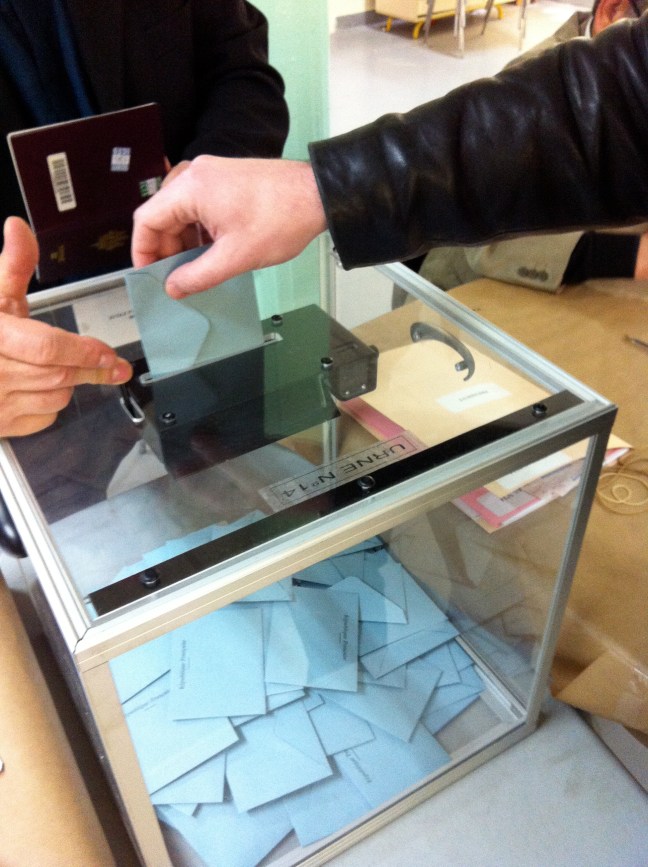
“Aux urnes, citoyens!” • “To the ballot boxes, citizens!”

Today, like some kind of United Nations election observer (or a self-appointed election journalist for the online media), I witnessed my first foreign election in progress. April 22, 2012 : It’s the first round of the French presidential elections, and I tagged along as Michel went to his polling place and exercised his franchise. It was a proud moment for him and for me. It was even memorialized on Facebook. Here’s the picture …
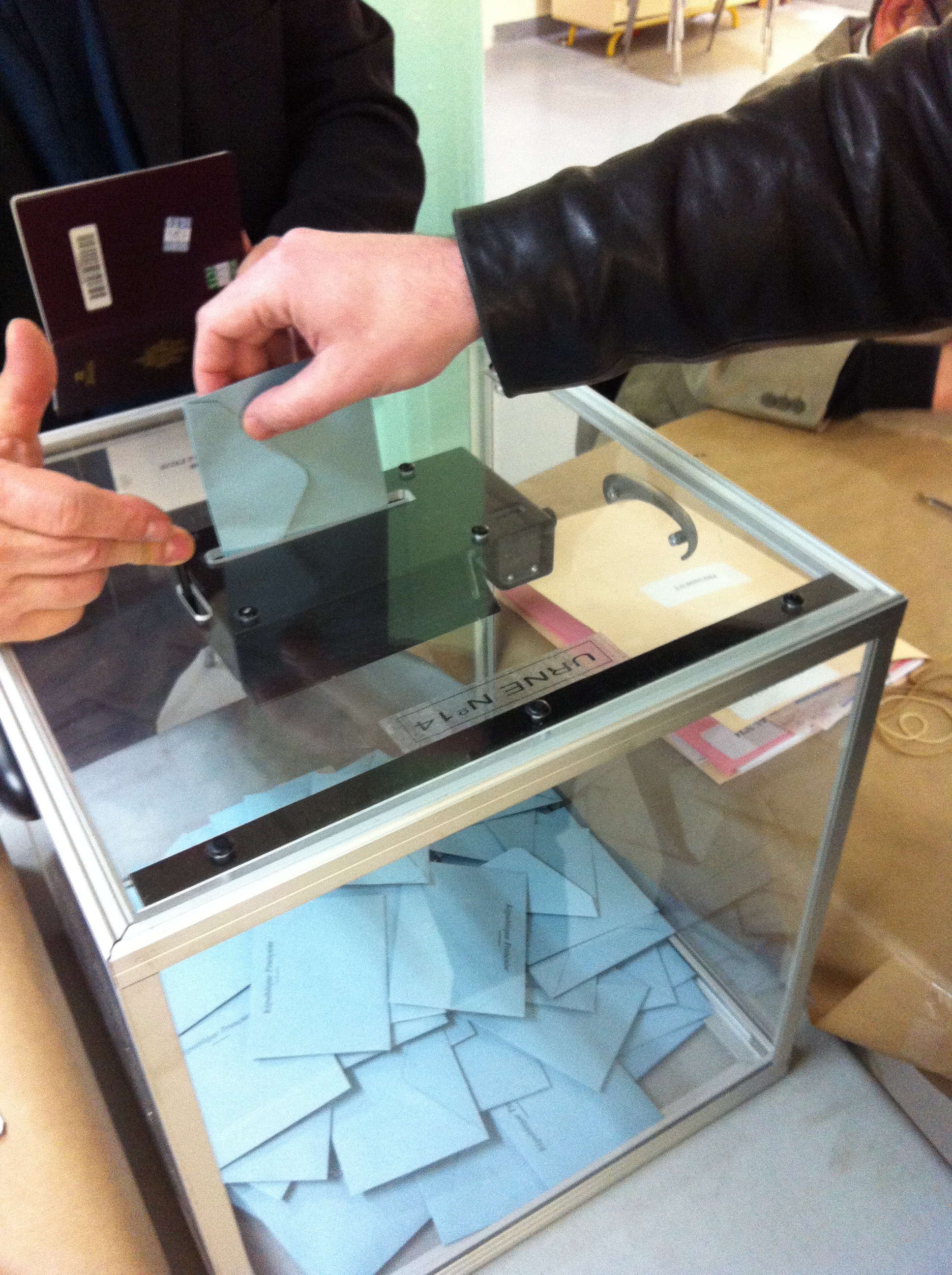
“Michel Denis Pouradier … a voté.” • “Michel Denis Pouradier … has voted.” © 2012 Samuel Michael Bell, all rights reserved

As an American — coming from a tradition that likes to view of itself as the father (even the guarantor) of democracy around the world — I found it very intriguing to watch the voting process here. As in America, the voting system differs from town to town, but here in La Courneuve, they still use paper ballots and ballot boxes (“urnes“). That struck me as both surprisingly outmoded and, somehow, so much more legitimate than pressing buttons on a touchscreen and watching your vote disappear into the ether. Watching Michel vote brought to mind images of elections in less developed countries that we Americans often see on our evening news, but also memories of my childhood, accompanying my parents to their polling place in rural South Carolina where, after having voted, they dropped their ballots in a little locked wooden box with a slot in the top. Nostalgia. Continue reading “Aux urnes, citoyens!” • “To the ballot boxes, citizens!”

French Carolina

Carolina was an English colony, of course, but did you know that the French actually beat the English in the race to get there? Of course, the Spanish beat them all in 1526. Quelle surprise. Their settlement, San Miguel de Gualdape, was actually the first European settlement in what is now the United States, possibly located near the site of present-day Georgetown, South Carolina. Unfortunately for the Spanish, though, San Miguel was abandoned after only 3 months when famine, disease, and unrest among their Native American neighbors forced the settlers to return to Santo Domingo. The French arrived in 1562, after Admiral Gaspard de Coligny organized an expedition to settle the region. The expedition, led by Norman navigator Jean Ribault, built Charlesfort on present-day Parris Island but, like the Spanish before them, they didn’t stick it out for very long. Ribault, having returned to Europe for supplies, was detained because of the French wars of religion, leaving his fledgling settlement to founder. After only one year, all but one of the 28 remaining settlers set off across the Atlantic in a makeshift vessel. You may have read about their fate: by the time they were rescued by a passing English ship, the unfortunate crew had already resorted to cannibalism to stay alive as they drifted aimlessly on the ocean. Meanwhile, the Spanish sent an expedition from Cuba to destroy Charlesfort, and the French experiment in colonizing the area came to an end. It wasn’t the end of French settlement though …

Continue reading French Carolina

Mike Bell: Cowboy, Alligator Wrestler

Being an American in France has given me, rightly or wrongly, a certain mystique thanks to the preconceptions of my French family and friends. Some of their preconceptions, of course, are not ones I readily embrace, however true they might be. Others, I tend to play up, however true they might not be. One of those embraceable preconceptions is that I’m some sort of cowboy.

Part of the attraction of “America” for some French people, I think, is the image of the cowboy as an American stereotype. Now, I’m certainly no Marlboro Man and I’d say I’m prone to being booted out of most roadhouses, but I have been on a horse, I have country line danced, and I do walk with a certain thumb-in-pocket swagger, even on the cobblestones of Paris. Growing up in the Deep South — in the country — and speaking with a certain drawl about subjects like hunting, tractors, and country-western music give me a certain “cowboy credibility” here … even though I’m a vegetarian, I’ve only shot my father’s rifle a handful of times, and the most farm work I’ve ever done was picking beans in my parents’ garden. Nevertheless, if they want to see me as a cowboy, I’m more than happy to oblige.

Last week, when I was in South Carolina, my parents and I traveled down to Hilton Head to visit my aunt and uncle. Now, we all know that Hilton Head is not exactly the Okefenokee, but I knew there’d be alligators there and I was anxious to snap a few good shots to impress Michel, who was back in France. The evening after we arrived, my uncle and I went out searching for alligators in the neighborhood and just when we thought there were none to be found, we happened upon a big daddy gator sunning himself on the bank of a pond. Like an American Crocodile Dundee, I sprang into action … Continue reading Mike Bell: Cowboy, Alligator Wrestler

Our Daily Bread

April 2009. The beginning of a great love affair. © 2012 Samuel Michael Bell, all rights reserved

One of my favorite things about living in France is the bread. The French, as you know, have a knack for making great things in the kitchen, and their bread is undoubtedly one of their finest products. I often joke that the reason I’ve gained about 7 kilos (that would be 15 pounds) since the summer of 2009 is the fact that French bread is so readily available. In Paris, you can’t walk for more than 2 or 3 blocks without the scent of freshly baked baguettes enticing you into a boulangerie like some siren song for your waistline.

This is also why I’ve often said that I can’t really eat American bread anymore. My palate has become so snobbish about bread that I even turn my nose up at the creations of the very artisanal American bakeries that I formerly patronized and touted to the world, and I even claim that Le Pain Quotidien just tastes different in America than it does in France. I’ll never forget Michel‘s first visit to Washington back in December 2009, when I went searching for a baguette for dinner, hurrying home with a pain de campagne from my neighborhood bakery because they didn’t have any baguettes, only to blush with embarrassment upon realizing that it simply didn’t measure up to what Michel was used to eating—what I’m now used to eating. That’s why I chose a warm, fresh tradition for my last lunch in France before leaving for the U.S. last weekend. I had to get my fix before starting this two-week sojourn in the land of Merita and Sunbeam, you know. Continue reading Our Daily Bread