Labor Disputes, Wooden Shoes, and Italian Bread
Today’s “French English” word is “sabotage.” Everyone, I’m sure, knows what sabotage means: as a verb, it means to deliberately destroy, damage, or obstruct something; as a noun, it’s the act of doing that. But where does the word come from? As it turns out, “sabotage” has a direct relation to wooden shoes. “Wooden shoes?” you ask. Why, yes. Here’s how …

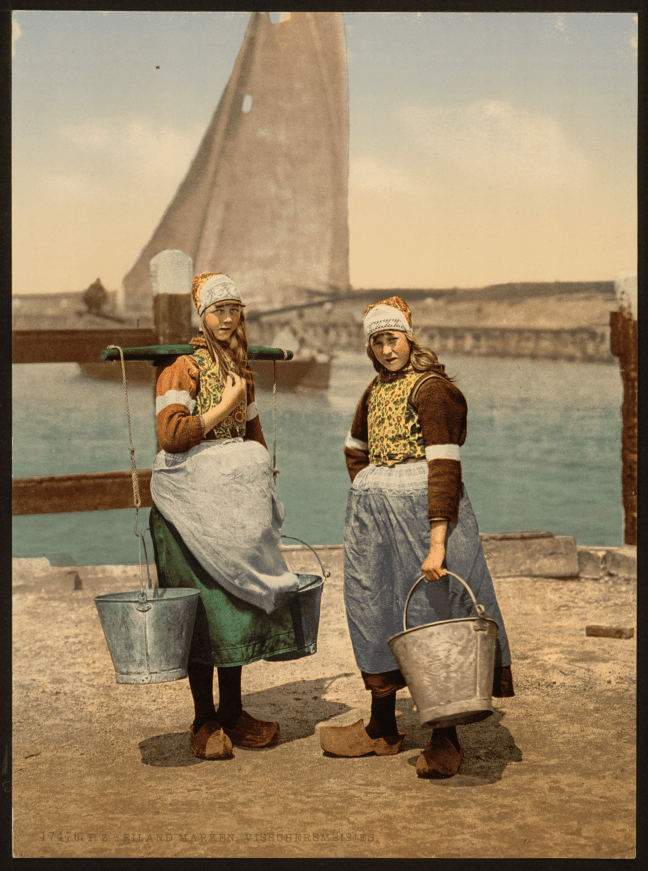
We generally associate wooden shoes with the Dutch, of course, who are often stereotypically depicted wearing them while picking tulips in front of their windmills. They weren’t the only people, however, who traditionally wore these clunky things; in fact, they were common among peasants all over Europe, including France, where they were called “sabots.” Eventually, sabot also became a slang term for the poor country folk who, during France’s Industrial Revolution, were brought into the cities to work in the factories when city dwellers went on strike. The verb “saboter” had originally been used in French to mean “to knock or tap with the foot” or “to walk noisily,” from the sound the wooden shoes would make on cobblestones, but with the arrival of these sabots in the factories, the word took on a new meaning. Because the sabot-wearing peasants weren’t familiar with the modern machinery, saboter became slang for “to bungle a job” and “sabotage” became the slang term for their poor quality work. Every strike has its end, though, and the city-dwelling workforce eventually returned to the factories. But they’d apparently learned a new bargaining tactic from the sabotsContinue reading Labor Disputes, Wooden Shoes, and Italian Bread

I Dreamed a Dream

"The Dream Lives"
“The Dream Lives”

Now that Les Caramels Fous are on vacation until the September reprise of Pas de Gondoles pour Denise, I can turn my attention to another musical, one with a slightly larger production budget: the latest adaptation of Les Misérables. There have already been at least 55 film and television adaptations of Victor Hugo’s novel of the same name, but this will be the very first film adaptation of the musical. The Christmas 2012 release will be director Tom Hooper’s first feature film since The King’s Speech, and expectations are accordingly high. His adaption of the word-renowned musical will bring to the screen such big names as Hugh Jackman (as Jean Valjean), Russell Crowe (as Inspector Javert), Anne Hathaway (as Fantine), and Helena Bonham-Carter (as Madame Thénardier), as well as such lesser known, though no less talented, stars as Amanda Seyfried (as Cosette), Eddie Redmayne (as Marius), and Samantha Barks (as Éponine). Perhaps surprisingly, even Sacha Baron Cohen (yes, that Sacha Baron Cohen … of Borat, Brüno, and Dictator fame) will make an appearance as Thénardier. Come to think of it, he might just be perfect for the role. All in all, that’s quite an impressive cast.

Les Mis was the first musical I ever saw, some 20 years ago, and watching the adaptation for the silver screen this Christmas will be the first time I will have seen it since. The musical version of Hugo’s masterpiece treats the same themes of broken dreams, unrequited love, redemption and social justice as does the novel, but the musical does it in a way that only musical theater can: Continue reading I Dreamed a Dream

Vanessa and Johnny?!

Reader Advisory:
The following is about as “People Magazine”
as you’re ever going to get from je parle américain

The Beautiful Couple

You could almost hear the gasps among certain of our friends on Facebook tonight when the news hit that French model and music star Vanessa Paradis and her partner, American film superstar Johnny Depp, were splitting up. Before tonight, I dare say that many of my friends back in the States would’ve been hard pressed to even come up with “Mrs. Depp”‘s name, but she’s a veritable institution here in France, and her Bohemian love story and family life with Johnny were almost legend.

Johnny and Vanessa’s love story started in Paris back in 1998, when Johnny noticed Vanessa across the bar of the Costes Hotel in Paris. According a People Magazine piece from 1999, Vanessa told her friend and biographer Alain Grasset that she “spotted [Johnny] pretty soon after he noticed her” and the two “were exchanging secret glances. When he invited her to his table, he made a place for her to sit down and … she went straight for it.” They spent a few hours talking, there were fireworks, and the rest is history.

Romantic huh? Maybe it reminds you of another story you’ve heard? About glances across a crowded bar and the beginning of an international love story? Yeah? No? Maybe? Okay, click here for a reminder. Michel and I used to joke about Vanessa and Johnny being our “celebrity couple analogs” … or, as I like to describe it, “Sultry French singer meets devastatingly handsome American.” Okay, so maybe the analogy isn’t spot on, but it’s good for a chuckle over drinks with friends … or for the hook of a blog post. Ahem. So, getting back to the story at hand …

Continue reading Vanessa and Johnny?!

What a Year It’s Been!

Happy Birthday to je parle américain!

It’s hard to believe that je parle américain is celebrating its first birthday today. It seems like just yesterday (to me, at least) that I posted the headline that read “Big change of focus underway … if Julie Powell can do it, so can I.” Two days later, I published my first ever blogpost: “So what’s this all about?” where I announced that what had been the website for my stalled “English language consultancy” would henceforth be the online diary of this American in Paris, where I would recount for your entertainment my experiences as an expatriate in the City of Light.

The French Bureaucratic Migraine

Well, since then, I’ve recounted a lot for you. I’ve complained quite a bit, of course; I’m pretty good at that. Surprisingly, it doesn’t seem to have bothered you much (with one or two notable exceptions). In fact, it seems that I get my biggest spikes in readership when I complain about, oh, I don’t know … the perpetual headache of French bureaucracy … or getting mistreated by Parisian waitstaff on the Fourth of July … or how filthy my neighborhood is. I want you to know, dear readers, that I sincerely appreciate your support and commiseration. When the burden of expatriate life gets you down, there’s nothing like a pat on the back from compatriots back across the ocean to make you feel better, or from fellow expats here in France to make you feel less alone.

Continue reading What a Year It’s Been!

Make Yourself Comfortable

One of the “French English” words that I love most is “comfortable” because … well, like most people, I like being comfortable in a comfortable place. That’s one of the great things about the word — it can describe both someone who’s in a state of physical or mental comfort and the thing or condition that makes them that way. “I’m so comfortable when I’m lying in my comfortable bed!” Like that. Little did I know when I came to France, though, the French equivalent “confortable” doesn’t work quite the same way …

As much as I like being comfortable, I like to know that the people around me are comfortable, too. I’m almost nebby about it … “Is everything alright? Are you okay? Can I get you something? Are you comfortable?” Whether it was on the sofa while watching a movie, in a train on our vacation, or during a quick aside when meeting my family or friends, I was constantly asking my husband Michel if he was comfortable …

Ça va? Tu es confortable?

On the outside, Michel was telling me that everything was fine but, on the inside, he was apparently laughing at me. Continue reading Make Yourself Comfortable

No Gondolas for Denise

© 2010 Les Caramels Fous, used courtesy of the company

Most of you know that I’m married to an amateur singer and dancer. Michel has been a member of a musical theater troupe here in Paris called Les Caramels Fous (“The Crazy Caramels”) for about four years. While they may not be a professional company, let me assure you that the musicals performed by this thirty-year-old all-male, all-gay troupe are anything but amateur. When I first met Michel in April 2009, he was getting ready for the premiere of the Caramels’ musical Madame Mouchabeurre (“Mrs. Butter-Fly”), a comic retelling of the opera Madama Butterfly set in Brittany in the 1950s and 1970s. Michel played several roles, including a Breton woman wearing an outfit from the ’50s, a Breton man in traditional costume, a French sailor, and an American paratrooper. Madame Mouchabeurre had three highly successful runs here in Paris in June 2009, October/November 2009, and June/July 2010, the Caramels playing three performances a week to packed houses for three- or four-week stints each time. Starting in November 2010, the Caramels took Madame Mouchabeurre on the road for several more performances all around France: Charleville-Mézières (Ardennes), Nantes, Fréjus, Merignac (Bordeaux), Blagnac (Toulouse), La Baule, and Nice, before returning to Paris for another performance at Puteaux last December. Continue reading No Gondolas for Denise

A Day to Remember

The United States and France have a long relationship, and like all relationships, ours has had its ups and downs. Born during our Revolution, Franco-American friendship is, of course, the complex product of our two countries’ unique histories and the moments when our paths have crossed — moments when we have shared the same struggle and the same vision of the way the world should be.

Perhaps no moment in our shared history demonstrates the strength of our friendship and common cause more so than D-Day, June 6, 1944 — when 73,000 Americans, 61,715 British, and 21,400 Canadians landed on the coast of Normandy to begin the liberation of France from Nazi occupation. That operation, codenamed “Neptune,” was the largest amphibious assault in history, and formed the spearhead of “Operation Overlord,” the military operation to liberate northern France. The D-Day operation has been memorialized in our history books, in stories handed down from veterans to their children and their grandchildren and, of course, in our popular culture. It was not only an effort by American, British, and Canadian forces to liberate occupied France, however, but one closely coordinated with the French Resistance, whose support on the ground was indispensable to the operation’s success.

Continue reading A Day to Remember

Chipotle: The Final Analysis

© 2012 Samuel Michael Bell, all rights reserved

Thursday, I wrote how ecstatic I was about the opening of a Chipotle Mexican Grill here in Paris because I could finally get my Mexican fast food fix. Obviously, like any great international city, Paris has an array of good Mexican restaurants, but every now and then, you just crave that mass-produced, no-surprise flavor you get from fast food. Before coming to live in Paris, I had become a big fan of Chipotle, so when I first heard that they’d opened a location here, I made plans to go there for the lunch the very next day.

Now, before I get to my review of Chipotle Paris, I should note for those of you who are not aware that American fast food often undergoes a slight transformation when it crosses borders and oceans. It makes sense, I guess, that fast food restaurateurs want to ensure, while staying true to the brand, that what they serve overseas will also appeal to the local palate. I’ll never forget the first time I encountered this as a high school student traveling to London in 1989. After just a few days of subsisting on the rather bland English fare served up at our hotel, a few of us set out on a foraging mission to find something quintessentially American. (After all, you can only eat roast beef and garden peas for so long.) We descended on the first Pizza Hut we could find, already salivating over the Super Supreme pan pizzas we were going to order. We weren’t at all prepared to find on the menu such “foreign” creations as prawn pizza or chicken and sweet corn pizza. The same is true in France, of course, where even KFC and McDonald’s offer several menu items that were clearly dreamed up by a kitchen team with absolutely no American members. Take for instance, the most recent addition to the French “McDo” (pronounced “mac-doe”) menu:

Continue reading Chipotle: The Final Analysis