First Class

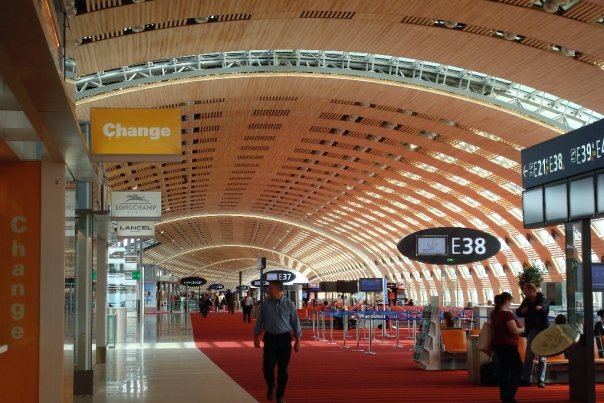
Terminal 2 at Roissy-Charles de Gaulle © 2012 Samuel Michael Bell, all rights reserved

One of the benefits of extensive foreign travel is a really FAT frequent flyer account, and since meeting my French husband, Michel, back in 2009, I’ve certainly racked up the miles. In 2009 alone, I flew back and forth between Washington and Paris four times on Air France, traveling almost 32,000 miles. I added 16,000 more miles to my travel log in February and April of the following year. That’s almost 50,000 miles traveled between Washington and Paris in just one year’s time! Aside from swelling my carbon footprint to shameful proportions, all that jetting back and forth got me a free one-way ticket to Paris in 2010 to begin my French expatriate adventure.

I should say up front that I prefer Air France to any American airline I’ve ever flown. I’m proud to be an American and all, but let’s face it: there’s something infinitely more charming about free-flowing champagne, wine, and cognac served up by French flight attendants wearing foulards than anything you normally get on an American flight … and I’m just talking about economy class, here. In fact, Air France doesn’t even call their upscale version “economy class” or “coach class”—it’s “voyageur.” Just read that out loud and you’ve already got a French accent!
Continue reading First Class

Fried Green Christmas

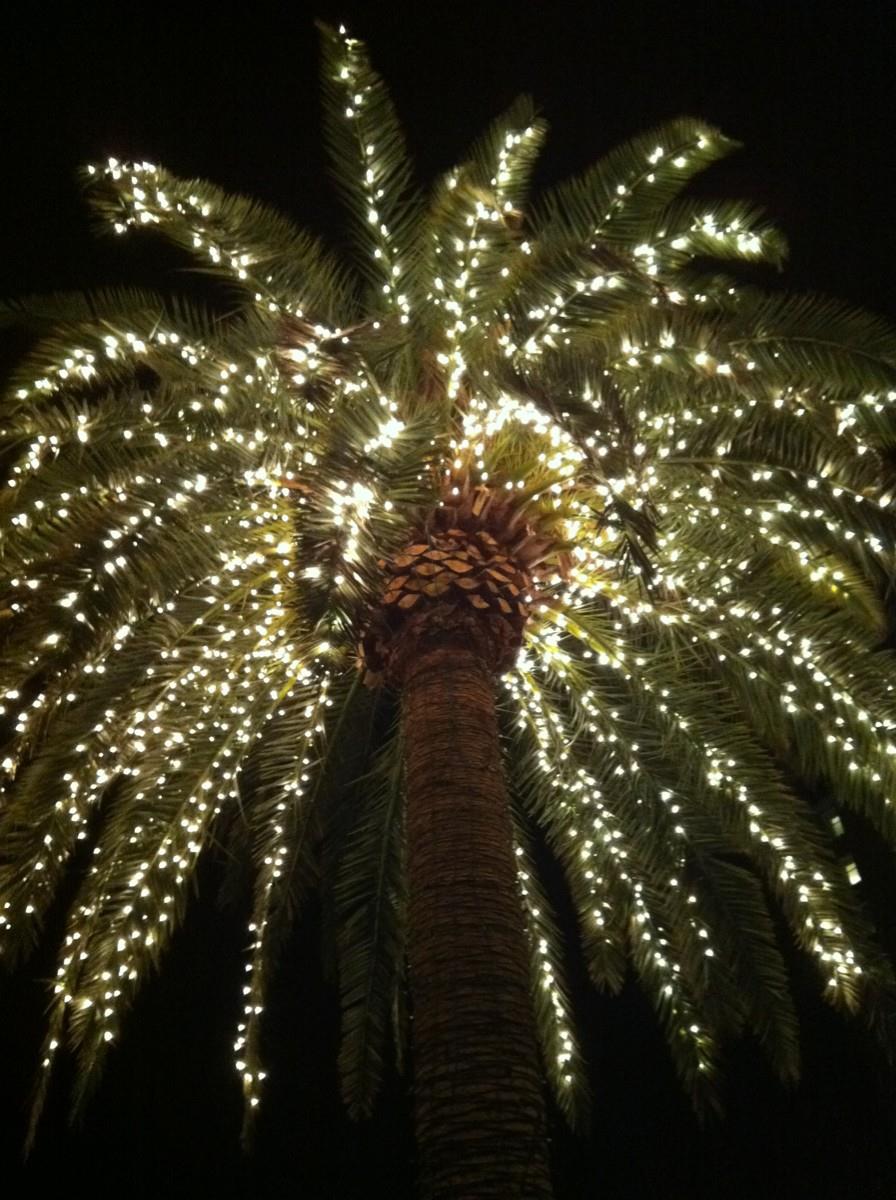
Palmetto tree lit up for Christmas in Marion Square, Charleston, SC © 2011 Samuel Michael Bell, all rights reserved

It’s been far too long since my last post, and I apologize for that, dear readers. On December 17, we left Paris for the United States to spend Christmas in South Carolina, a trip I’ve nicknamed a “Fried Green Christmas” in homage to my mother‘s Southern cuisine. Since arriving last Saturday, we’ve decorated the Christmas tree and put up Christmas lights, we’ve visited family and friends in Columbia (spending an hour driving through a Christmas-light installation in a 400-acre park), we’ve spent a jam-packed 24 hours with my parents sightseeing in almost-tropical Charleston, surrounded by Christmas lights in palmetto trees, and we’ve finally finished up our Christmas shopping and gift wrapping.

Today, we’ll be joined by my aunt and uncle for Christmas dinner. There will be 6 of us at the table, but only 4 carnivores. Nevertheless, my mother has cooked a 7-lb. Christmas ham (you know, the one decorated with pineapple rings, maraschino cherries, and cloves), and 3 … yes, count ’em … 3 small chickens! That, along with the best carrot cake I’ve ever tasted, means we’re well on our way to packing on a few pounds before those New Year’s resolutions next weekend! Continue reading Fried Green Christmas

Lenny Kravitz’s Favorite Falafel

L’As du Fallafel, certified Kosher—”always imitated but never duplicated” © 2011 Samuel Michael Bell, all rights reserved

I’m often asked if it’s hard being a vegetarian in Paris. The question makes a lot of sense. After all, when you think of French cuisine, you probably conjure up images of bœuf bourguignon, coq au vin, foie gras, even escargots. And ham, well, ham is practically its own food group here. The truth is, though, that between cheese crêpes and savory tarts (as long as there are no lardons in there), I’ve never really had much trouble finding something to eat. But one of the best things about being a vegetarian in Paris isn’t even French …

it’s falafel. Continue reading Lenny Kravitz’s Favorite Falafel

Up, up and away …

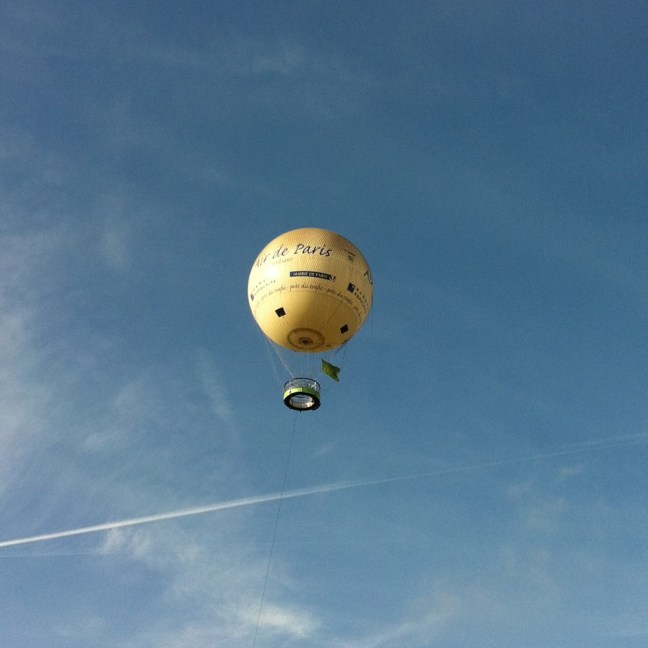
Saturday afternoon, I joined some friends at Parc André-Citroën to do something I’d never done before: ride in a balloon! That’s right. Perhaps surprisingly, this almost 40-year-old had never, ever gotten inside the basket of a hot air-balloon to make an ascent. It’s not that I’m afraid of heights. (I have, after all, been to the top of the Eiffel Tower, the Empire State Building, and the Sears Tower in Chicago. I’ve even gone parasailing.) It’s just that, for whatever reason, I had never gotten around to doing this before yesterday.

I was invited by a friend who was doing field research for a presentation on Parc André-Citroën. This 59-acre park was constructed on the site of the 1915 Citroën factory, where André Citroën built one of the first fleets of French automobiles. That factory closed in the 1970s, and the city of Paris purchased the property and opened the park in 1992. The park features an expansive central lawn around which are situated two greenhouse pavilions, “dancing fountains” where kids (and adults) can play in the spray of the jets during the summer, a reflecting pool traversed by a suspended walkway, and six ornamental gardens. But what drew me to Parc André-Citroën yesterday (in addition to catching up with friends, of course) was the opportunity to take a ride in the Ballon Air de Paris. Continue reading Up, up and away …

An American … no, make that eight Americans … in Père Lachaise

Your Guide to Père Lachaise © 2011 Michel Pouradier, all rights reserved

Best known to most Americans as the final resting place of Jim Morrison, Le Père Lachaise cemetery is the largest graveyard in the city of Paris, occupying 110 acres in the 20th arrondissement and having over 1 million interments. I can still remember my first visit to Père Lachaise back in April 2009—it was nothing like I had expected. There, in the center of a bustling multi-ethnic quarter, was a veritable city of the dead, with streets that actually bear names and divisions that function somewhat like little neighborhoods. It was even large enough to have a map with an alphabetized key for locating the grave sites of literally hundreds of its most famous occupants. I spent a few hours during that first visit, strolling along wide, tree-lined avenues and down narrow, winding cobblestone chemins in search of such luminaries of French literature, music and history as Honoré de Balzac, Marcel Proust, Georges Bizet, Jean de la Fontaine, Édith Piaf, Molière (who isn’t really there, but that’s another story), and even the legendary twelfth-century lovers Abelard and Héloïse (at least according to the 1817 marketing scheme to attract cemetery plot purchases).

Continue reading An American … no, make that eight Americans … in Père Lachaise

“Give me your tired, your poor …

… Your huddled masses yearning to breathe free.”

— Emma Lazarus, The New Colossus

It was Saturday afternoon and I was racking my brain for an idea for my next blogpost. The pressure was mounting since I try to post at least twice a week and the last post was on Wednesday … and then I Skyped with my mom.

“Did you see the Statue of Liberty celebrations?”

“Um. No. What was that about?”

“Yesterday was her 125th birthday.”

Voilà ! Merci maman !

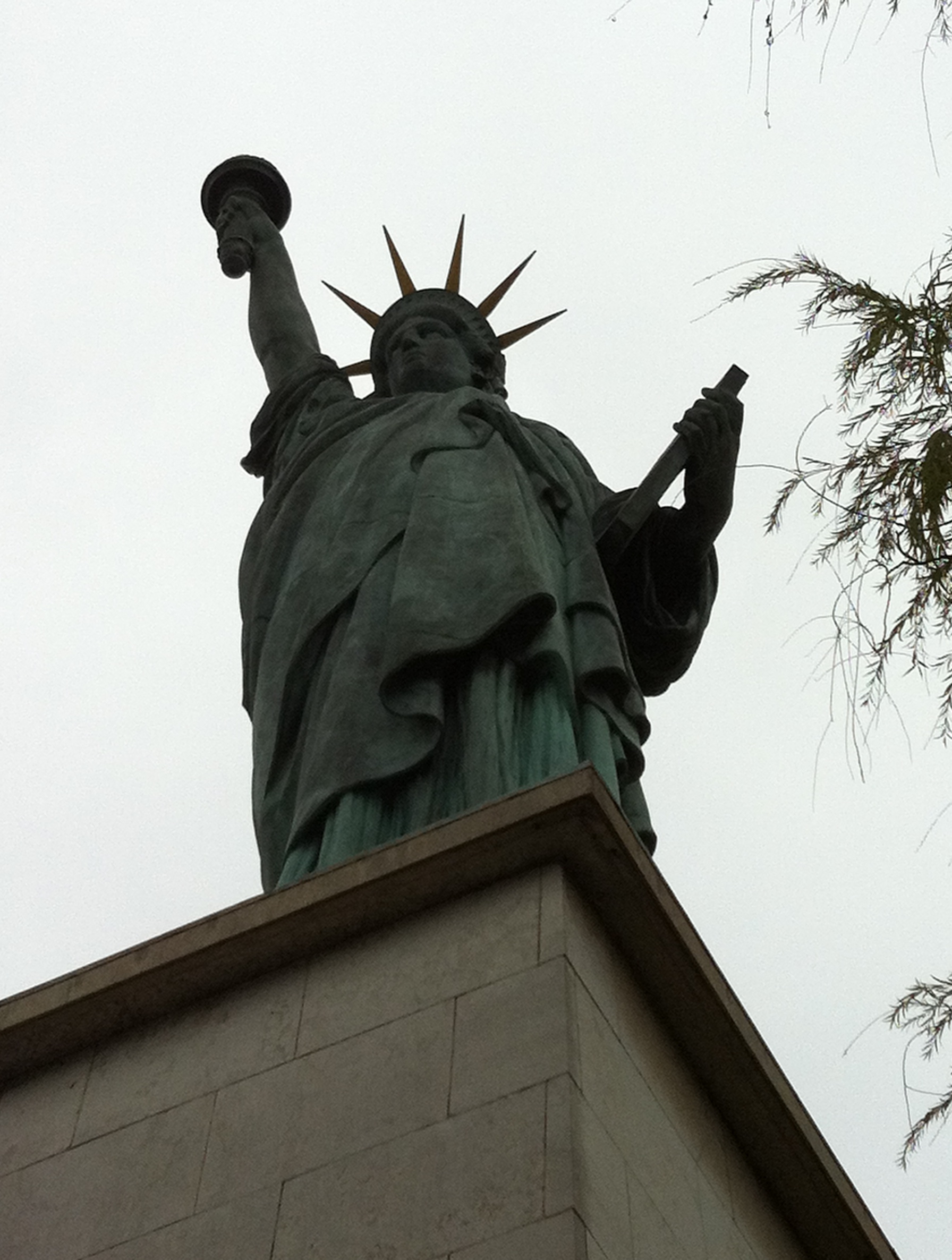
It’s hard to think of a more iconic symbol of the United States than the Statue of Liberty. From postage stamps to commemorative coins to old New York state license plates to television and films, it is an unmistakable image that evokes America. Almost everyone knows that the statue was a gift from the people of France to the people of the United States, but the details of the story are always more fuzzy once we leave grade school. And most Americans aren’t aware that, right here in Paris, we have our very own replica one fourth the size of the original in New York. It was made by the sculptor using one of his design moulds and was presented to the city of Paris in 1889 by the American community living here to commemorate the centennial of the French Revolution. Just this afternoon, I ventured out to the Île aux Cygnes, a narrow island in the Seine just downriver from the Eiffel Tower, to take a look at the replica for the very first time.

La Statue de la Liberté, Île aux Cygnes © 2011 Samuel Michael Bell, all rights reserved

Having been inspired by my little afternoon excursion, I came home to finish up this post, the backstory of Lady Liberty’s 21-year voyage from idea to icon.

Continue reading “Give me your tired, your poor …

Cold War on Line 7?

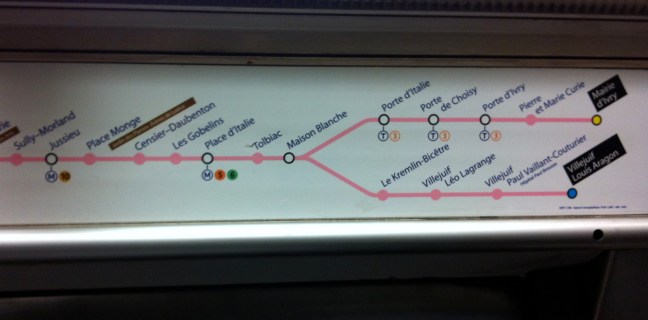
I live in La Courneuve, at one end of line 7 of the Paris Métro. I spend a lot of time riding on that line, looking at its long list of stations during my daily trips back and forth to Paris. Scanning that list recently, I noticed what seemed to be some strange homage to the Cold War: the end of World War II … the White House … and the Kremlin.

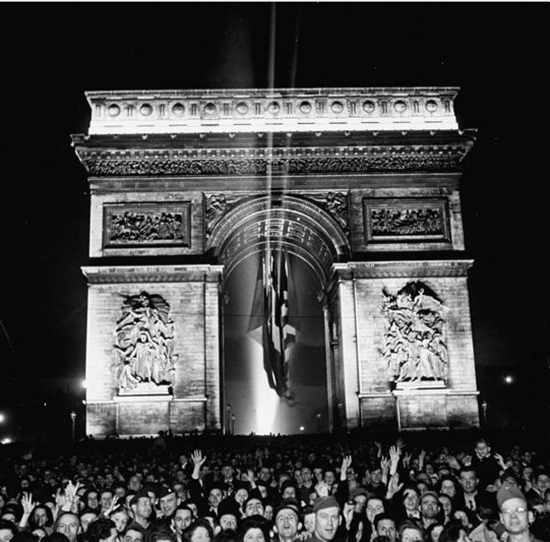
V-E Day in Paris, May 8, 1945

The official name of the La Courneuve station is La Courneuve—8 mai 1945. The date refers to V-E Day, or Victory in Europe Day: the end of the Second World War in Europe, when Germany’s act of military surrender was officially ratified in Berlin. While we don’t celebrate May 8 in the United States, it’s celebrated widely in Europe as a public holiday. Nothing really noteworthy in having a station named in honor of the end of the war, right? Towards the other end of line 7, however, two more stations drew my attention: Maison Blanche and Le Kremlin-Bicêtre. That got me thinking. “Maison Blanche” means “White House” and “Kremlin” … well, “Kremlin” means “Kremlin.” (I’ll admit, I had no idea what “Bicêtre” meant.) “How interesting!” I thought. At one end of line 7 we’ve got the end of World War II and at the other end, we’ve got the White House and the Kremlin! Hmm …

Continue reading Cold War on Line 7?

An American in the Métro

© Simon Law

There’s something quintessentially Parisian about the Paris Métro. From the art nouveau entrances to the winding corridors to the white-tiled walls and ceilings, there’s simply no confusing the Paris Métro with any other underground transit system in the world. But did you know how American a few of the Métro stations are? For most French, these stations are probably no more interesting than, say, Boucicaut or Bréguet Sabin, but for an American, they’re little souvenirs of home right here in Paris. Continue reading An American in the Métro

skwerl

As an English-speaker living in France, I know what it’s like to be in a room full of people speaking French, not understanding everything that’s being said. You hear the “sound” of the language, peppered here and there with words and phrases that are familiar; you struggle to put it all together and make sense of the situation. Here’s a brilliant take on what it must sound like for a non-English speaker to listen to us speak our language. Bravo to the writers, the director, and the actors in this excellent short film!

© 2011 Samuel Michael Bell, all rights reserved

Beautiful Ambiguity

© Paramount Television

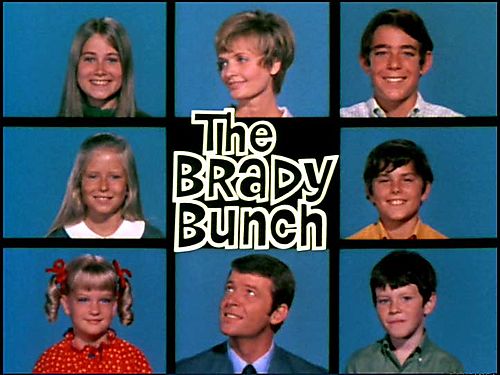
One of the most charming things about French family life is the way one expresses both the “step” and “in-law” relationships. In English, we use the prefix “step” to denote that a relationship has been created by the marriage or coupling of a new, non-biologically-related person with one’s parent. For example, your stepfather is the man who marries or co-habits with your mother after the end of her relationship with your father. Stepbrothers and stepsisters are pre-existing children that come into the family because of this new couple. Think of The Brady Bunch: Mike was Marcia, Jan, and Cindy’s stepfather; Carol was Greg, Peter, and Bobby’s stepmother; the girls were the boys’ stepsisters; and the boys were the girls’ stepbrothers. Conceivably, one could extend the prefix to other family members, as well. We use the suffix “-in-law,” however, to describe the relatives of one’s spouse. For example, your father-in-law is the father of your husband, and your sister-in-law is his sister. Again, one could use the suffix for extended family members as well.

Fairly clear and straightforward, right?

For an anglophone, though, the French way of describing these relationships can seem quite confusing. Continue reading Beautiful Ambiguity