So, while we’re on the subject of American cultural exports, let’s consider Coca-Cola. Coca-Cola is certainly the most widely-recognized American export to the world: certainly more so than Ford, or Levis, or even McDonalds. Here in France, ordering “un Coca” is as commonplace as ordering “a Coke” back in the U.S., but there is a difference here—and I’m not just talking about slightly smaller cans and much higher prices—I’m talking about the taste.
To be upfront about this, I haven’t been a “regular” Coke drinker for quite some time. With my metabolism, I just can’t afford all those extra calories, so I almost always drink Coke Zero. Every now and then, though, when I want to splurge, I do have regular Coke (or “Coca normal” here). The first time I drank a Coca normal here in France, I was struck by how good it tasted! Was it that I hadn’t had one in a while? Or was it some special recipe for the French market? (I knew that in certain markets, the recipe is tweaked to appeal to local tastebuds.) Continue reading Why Coke Tastes Better in France
Living in France, you quickly take note of the big cultural differences: the French speak French, they complain about everything almost as much as I do, they have a knack for nonchalance par excellence (which I’m still working on acquiring), they are still champion smokers. After a while, you also pick up on the little things … like obsession with peanut butter.
It’s a really funny observation when it first strikes you. Peanut butter is not at all a common food item in France. When you go to the supermarket, you see lots and lots of jellies and jams of every conceivable flavor (including at least a dozen varieties of plums), an entire section of Nutella, more varieties of honey than you knew existed, and chocolate … shelves and shelves of really good chocolate. But you don’t see a lot of peanut butter. It’s still “exotic” here. Little French boys and girls never grew up on PB&J sandwiches the way we did. That’s why, I think, the French are absolutely enamored of this most American of foods. The proof: my luggage every time I travel back from the United States. Continue reading What is it with the French and Peanut Butter?
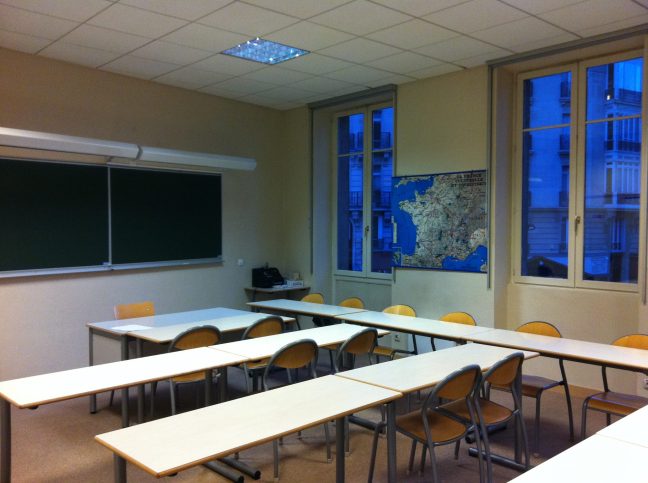
That’s right. I just finished up my third and final semester of French courses at the Cours de Civilisation Française de la Sorbonne. Last week, I wrote a 1,540-word paper on French-Canadian literature. Then, I spent an hour and a half answering the question “Why can we speak of a myth of progress?” for a “Myth and Modern Thought” seminar. On Saturday, I took my final exam in French grammar, reading comprehension, and written expression. Today, I cleared the final hurdle: the oral exam.
The oral exam has always been the most intimidating for me. Despite the fact that it only counts for maybe 10 or 20 percent of the final grade and only lasts for 10 or 15 minutes (as opposed to 3 hours for the written exam), there’s something infinitely more nerve-racking about sitting at a table across from two French professors and speaking in French about an excerpt from a work of French literature. To be honest, I think I spent more time studying for the oral than I did for the written exam: reading and re-reading eight different texts as disparate as Montesquieu’s Les Lettres Persanes and Albert Camus’s Le Premier Homme, summarizing each one, reviewing the more esoteric vocabulary, identifying the major themes, and then worrying about my pronunciation when it would come time to read aloud!
This morning, I was very lucky. I ended up drawing at random Baudelaire‘s L’Albatros. You might remember that this is the poem I never got around to memorizing for a recitation earlier this semester, despite our professor’s pleas. Of course, I didn’t have to recite it this morning, but I did have to read it aloud and—just to let you know—even reading French poetry with a English-speaking mouth isn’t an easy thing to do. But I did it and did it pretty well, if I do say so myself. It’s a good thing I practiced a few times with Michel this weekend! I explained the “story” of the poem and then moved on to discuss the analogy: the poet, like the albatross, is a “different” being, beautiful and graceful in his own world, but clumsy, misunderstood, and sometimes ridiculed when “brought down to earth” among the rest of us. I even got to talk about neoplatonism. How often does one get a chance to do that in an average day? After my ten minutes were up, it was time for the next student … and I was relieved to have reached the end.
Now that it’s all over, though, I’m already getting nostalgic. I’ll miss my classmates and my professor, who was one of the best I’ve ever had. Of course, as long as I live in France and as long as I have a French family (no matter where I live), I’ll keep learning French. It just won’t be in a classroom anymore … and that makes me just a little mélancolique.
I recently wrote that a fat frequent flyer account is one of the many benefits of extensive foreign travel. Another one (at least for me) is collecting all those entry and exit stamps that fill up the visa pages in your passport. Even in this day and age of digital technology, every time you cross a border, a border agent stamps your passport to show your port of entry (or exit) and when you were there. Over the years, your passport gradually turns into a jumbled-up journal of your foreign travel—full of tiny, sometimes colorful souvenirs of where you’ve been.
As you can imagine, since meeting my French husband back in 2009, I’ve gotten quite a few passport stamps from French passport control. And for every one of them stamped at Charles de Gaulle, I have a corresponding one stamped by American authorities at Dulles or Charlotte. As an expatriate, though, it’s not just entry and exit stamps that decorate my passport: I even have two entire pages taken up by my initial student visa issued by the French Embassy in Washington and my first residency permit issued after my arrival in France by the Office Français de l’Immigration et de l’Intégration. Just flipping through my passport, in fact, you see more French than English.
My stamps aren’t limited to French and American ones, though. I do have an eye-catching one in vivid green from a trip I took with my mom to Ireland in 2006, as well as a few British ones I got at Gare du Nord in Paris before taking the Eurostar over to London. What I don’t have, unfortunately, are stamps from Belgium or Hungary, my other two international destinations since getting my current passport. Since both countries are in Europe’s Schengen Area, you don’t even have to pass border control if you’re coming from another country in the Area—like France. That’s really too bad. It would have been really cool to have one in Magyar … or even Dutch.
The rub with all this stamping is that you only get 24 visa pages in an American passport. Now, that sounds like a lot since each page (the old style, at least) had 4 little boxes for stamps. Technically that gives you 96 passport stamps during the 10-year life of your passport … maybe even more since most passport control agents are pretty sloppy about placing their stamps. When you travel as much I have, though, and you’ve got other big things like visas and residency permits pasted in there, you can run out of room before it’s time to get a new passport.
The solution?
If you don’t want to order a new passport yet, just order new visa pages!
American passport holders can order up to two 24-page inserts that are affixed in the passport by the National Passport Center, or by the local consular officials if you’re living abroad. Late last year, when I realized that I was quickly running out of room in my passport that was valid for another 2-1/2 years, I figured I’d just take a trip to the Embassy one afternoon and ask for new pages. Of course, it’s never that simple! It turned out that I had to fill out an application and mail my passport to the Embassy. Now, I’m a little skittish about putting something as essential to my immigration status as my passport into the mail system … even the French mail system. No worries! The Embassy requires you to use something called a Chronopost envelope for both sending the passport and getting it back. It’s very secure and traceable—kind of like FedEx, but more expensive … a lot more expensive! Little did I know when I walked into a French post office last Thursday afternoon that each Chronopost envelope costs 22.50€! That meant that just mailing the passport to the Embassy right here in Paris (just 5 miles from where I live) and getting it delivered back to me was going to cost about $60! On top of that, the fee for the visa pages themselves was $82.
Sigh.
Oh well, at least that’s not as expensive as my residency permit was … oh … wait a minute. Yes, it is!
Sigh, again.
Of course, you might be asking why I didn’t just spring for an entirely new passport that would be good for 10 more years for the bargain basement price of $110. Good question. After all, my passport photo is of me about 25 pounds ago! The truth be told, I’m already having buyer’s remorse about my decision to just get visa pages, but here’s my story and I’m sticking to it: It has something to do with the fact that my residency permit is linked to my current passport number. Maybe I’m wrong about that and getting a new passport wouldn’t create a problem with the French immigration system at all. If you’ve been following my story here, though, you know that I don’t have any desire to open that can of worms just yet! I’ll just wait until 2014 to worry about that, thank you very much!
In any case, in what may be a record of bureaucratic efficiency, I got my newly made-over passport in the mail today … just 3 business days after sending it! Now, it’s off to enjoy my 24 brand spanking new visa pages! Where should I go? Somewhere outside the Schengen Area so I can get some use out of them, I guess … or I could just look for flights with connections through London or Dublin!
One of the benefits of extensive foreign travel is a really FAT frequent flyer account, and since meeting my French husband, Michel, back in 2009, I’ve certainly racked up the miles. In 2009 alone, I flew back and forth between Washington and Paris four times on Air France, traveling almost 32,000 miles. I added 16,000 more miles to my travel log in February and April of the following year. That’s almost 50,000 miles traveled between Washington and Paris in just one year’s time! Aside from swelling my carbon footprint to shameful proportions, all that jetting back and forth got me a free one-way ticket to Paris in 2010 to begin my French expatriate adventure.
I should say up front that I prefer Air France to any American airline I’ve ever flown. I’m proud to be an American and all, but let’s face it: there’s something infinitely more charming about free-flowing champagne, wine, and cognac served up by French flight attendants wearing foulards than anything you normally get on an American flight … and I’m just talking about economy class, here. In fact, Air France doesn’t even call their upscale version “economy class” or “coach class”—it’s “voyageur.” Just read that out loud and you’ve already got a French accent!
Once again, dear readers, I’ve waited far too long since my last post. Then again, a lot has happened since Christmas Day. I’ll fill you in in installments, though, so that you’re not overwhelmed. Here’s your first one:
How I spent three days of my Christmas vacation with a 14-foot U-Haul truck
You may or may not know that I still own an apartment in Washington, DC, where I lived for 8 years before moving to Paris in 2010. Since I haven’t really worked since 2009, maintaining a mortgage on that piece of prime real estate no longer made any sense and I put it on the market a few months ago. (Incidentally, if you’re looking for a beautiful, 1100-sq.-ft., 1927-build, Beaux-Arts apartment in Adams Morgan, send me a message and I’ll put you in touch with my broker!) What that decision meant was that I needed to move a LOT of furniture and personal effects out of the place, so Michel and I planned a three-day excursion to DC right after Christmas to load up what was left of my stuff and move it back to my parents’ place in South Carolina. That couldn’t possibly be TOO difficult, right?
It’s been far too long since my last post, and I apologize for that, dear readers. On December 17, we left Paris for the United States to spend Christmas in South Carolina, a trip I’ve nicknamed a “Fried Green Christmas” in homage to my mother‘s Southern cuisine. Since arriving last Saturday, we’ve decorated the Christmas tree and put up Christmas lights, we’ve visited family and friends in Columbia (spending an hour driving through a Christmas-light installation in a 400-acre park), we’ve spent a jam-packed 24 hours with my parents sightseeing in almost-tropical Charleston, surrounded by Christmas lights in palmetto trees, and we’ve finally finished up our Christmas shopping and gift wrapping.
Today, we’ll be joined by my aunt and uncle for Christmas dinner. There will be 6 of us at the table, but only 4 carnivores. Nevertheless, my mother has cooked a 7-lb. Christmas ham (you know, the one decorated with pineapple rings, maraschino cherries, and cloves), and 3 … yes, count ’em … 3 small chickens! That, along with the best carrot cake I’ve ever tasted, means we’re well on our way to packing on a few pounds before those New Year’s resolutions next weekend! Continue reading Fried Green Christmas
One of the great benefits of living in France is the socialized health care system. One of the great headaches of moving to France is the initial application process for it. My story (and, believe me, there is one) is just too exhausting and too long to recount in this post, so suffice it to say that I eventually got what I needed: Couverture Maladie Universelle (“CMU”), complete with my very own French social security number printed on a Carte Vitale. Until the end of November, my CMU was even “complémentaire” because my income was low enough in 2010 to qualify for coverage without any out-of-pocket fees. Vive le socialisme français! You might think that with that kind of coverage, I’d have used my CMU whenever I had a stuffy nose, but I didn’t. In fact, the first time I ever used it was just a few weeks ago, when I needed to get a cavity filled.
That experience can best be described as “factory dentistry“: intake at a big dental clinic without an appointment, lots of waiting, sixteen … count ’em SIXTEEN … bitewing x-rays plus a 360º head scan, followed by quick, no-nonsense filling of that little hole in my molar. After all of that, I walked out without paying for a single thing. I can’t complain about that. So, when I went for a dermatology appointment yesterday evening, I was expecting something similar … but that’s not at all what I got.
My appointment was at 5:30 pm, and I was running late because of a problem in the Métro. I asked Michel to call the office to let them know I was on my way; I didn’t want the dermatologist to pack up and go home before I could get there. Once I got off the Métro, it was relatively easy to find the address. I hurried past several medical offices en route so it seemed I was in the right neighborhood, but once I arrived I started to have doubts.
The office was located on the first floor of a poorly-lit, high-rise apartment building. Now, there’s nothing really out of the ordinary in that. After all, my dentist back in DC had the same kind of office arrangement. What was out of the ordinary was that I couldn’t find the office once I got inside the building. I walked back and forth along the first floor corridor searching for a little plaque with the doctor’s name … something … anything to distinguish her office from the rest of the doors that obviously led to residential apartments. Finally, after a few passes, I located it: the dermatologist’s name scribbled by hand on a tiny sticker (the kind you’d put on the tab of a file folder) just above the doorbell.
“Okay, that’s a little odd,” I thought.
I rang the doorbell and waited. The door opened halfway, and I was greeted by the visage of a short, frizzy-haired woman in a white doctor’s coat peering at me almost suspiciously from inside.
Good evening.
Good evening. I have an appointment at 5:30.
Your name?
Samuel Bell.
Come in.
“Okay, that’s a little odd,” I thought again.
When she opened the door, I caught my first glimpse of the waiting “room.” Frankly, it was more like a waiting “closet” … maybe 72 square feet … already occupied by 2 adults and 2 kids. I made my way over to the corner, sat down in the only available seat, and looked around: four dingy walls and four doors, each (except for the door through which I had come) marked with a hand-written sign denoting what lay behind it. I could hear the doctor with her patient behind the sliding door to the “examination room.” There were at least two more patients ahead of me, it seemed, so this was going to be a long wait, and for what, I was not quite sure.
After about 20 minutes, feeling ill at ease, I started searching for an excuse to leave … and then I found it. In her typical professional manner, the dermatologist had taped a handwritten notice to the wall. Just below the request to turn off our cell phones were the magic words:
Bank cards not accepted. Please pay the exact amount. Cartes Vitales not accepted (only CMU sheets).
I had no idea what a CMU sheet was, but as far as I was concerned, any dermatologist who couldn’t swipe my Carte Vitale and wanted payment in cash wouldn’t be curing my acne! I packed up my things and left, shaking my head.
All that’s to say that I’m still looking for the right dermatologist in Paris, preferably one whose office doesn’t evoke some underground medical operation. I won’t even mind if what I get is “factory dermatology” as long as I’m not hanging out in someone’s apartment and paying cash under the kitchen table.
When I moved to Paris sixteen months ago, I had what I thought was a pretty good plan: 20 hours a week as a French student and 20 hours a week as an English teacher. After all, I had always been attracted to the idea of teaching, even though I had never pursued it as a career. “Why not try it now?” I thought. “This is the perfect time, and this is the perfect place to start.” I had been assured that teaching English was the “easiest field to get into here” and, as an overeducated former lawyer, I thought I had a pretty impressive résumé.
As it turns out, it wasn’t going to be that easy. The truth of the matter is that native English speakers are a dime a dozen in this city, and most good teaching positions require a certification that I don’t have. The disappointment of discovering that I wasn’t a ready-made English teacher plus the demands of my own French classes ended up putting my plan on the back burner … that is, until I recently looked at my bank account and decided that it was high time to turn the heat up again. Continue reading I SPEAK American, but I TEACH English.
I’m often asked if it’s hard being a vegetarian in Paris. The question makes a lot of sense. After all, when you think of French cuisine, you probably conjure up images of bœuf bourguignon, coq au vin, foie gras, even escargots. And ham, well, ham is practically its own food group here. The truth is, though, that between cheese crêpes and savory tarts (as long as there are no lardons in there), I’ve never really had much trouble finding something to eat. But one of the best things about being a vegetarian in Paris isn’t even French …










 je parle américain