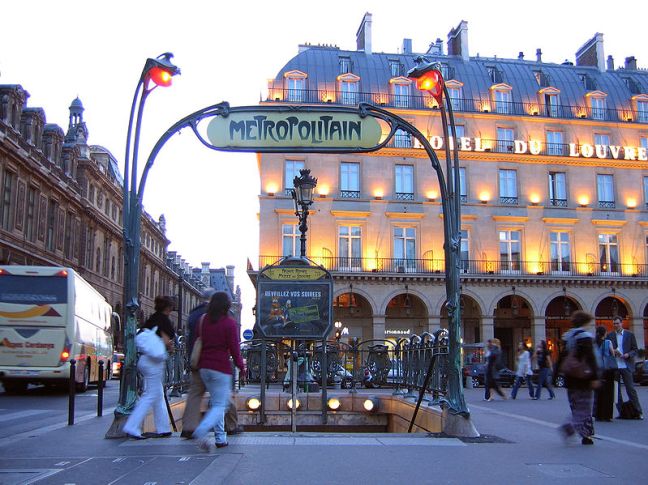
Le Métro

Photo: © Simon Law

If you’ve ever spent much time in Paris, you know that the Paris Métro is enormous: 16 lines, 381 stops in 297 stations (of which 62 provide correspondence between lines), and 132 miles of routes. It’s not as large as New York’s subway system, of course, which has 24 lines, 468 stops in 421 stations, and 209 miles of routes, but it is much bigger than the Metro system of my hometown of Washington, DC: the DC Metro has 5 lines, 118 stops in 86 stations, and 106 miles of routes.
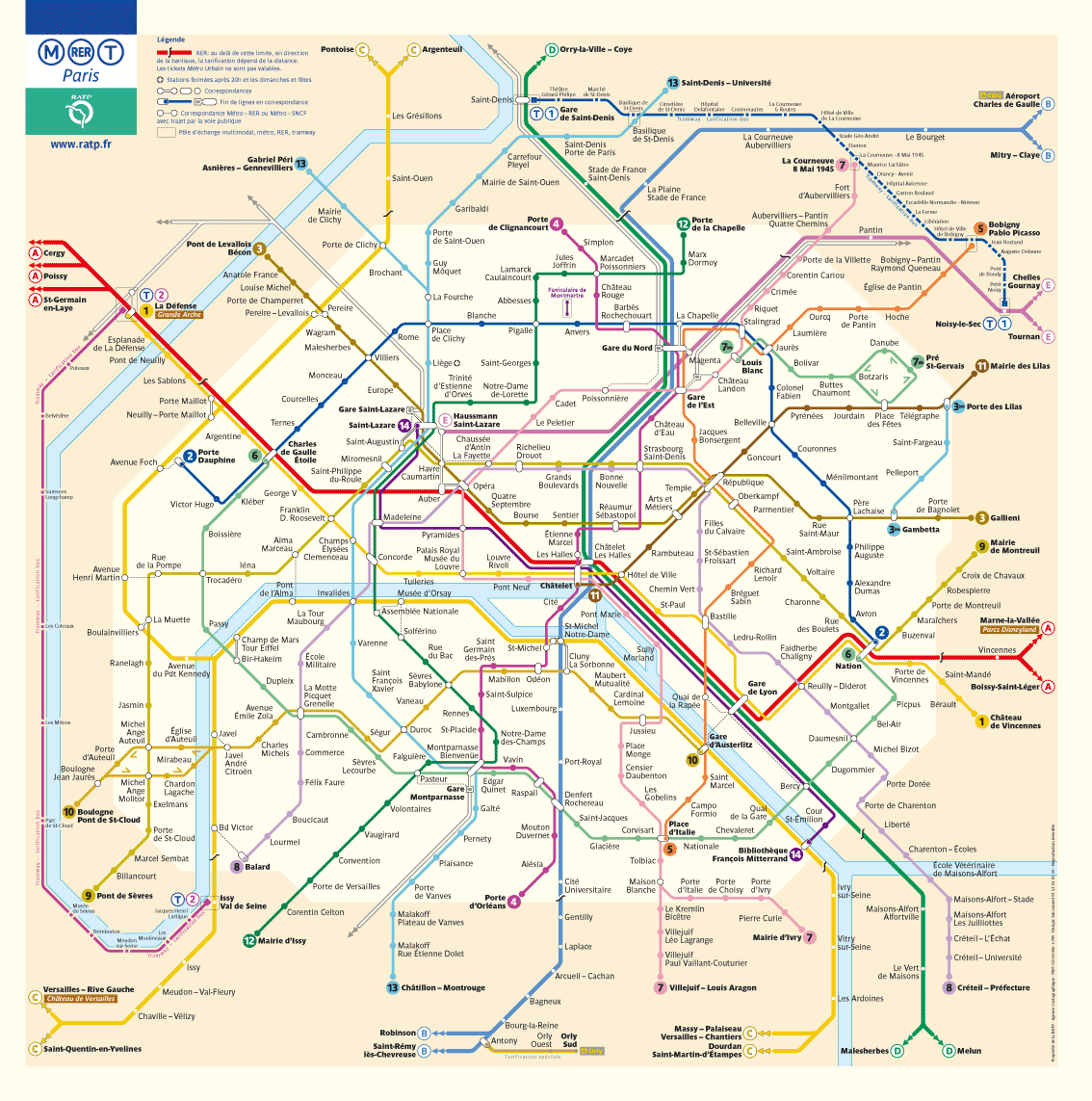
© RATP — The Paris Métro is enormous.

Paris’s Métro is one of the densest subway systems in the world, with 245 of its stations located within the 34 square miles of the city of Paris itself. Since the Métro was designed at the end of the nineteenth century to comprehensively serve the city, the stations are very close together: only 548 meters apart on average (about a third of a mile or 600 yards), ranging down to 424 meters (a quarter of a mile or 465 yards) on line 4 and up to one kilometer (about six tenths of a mile or 1,100 yards) on the newest line 14. With all these Métro stations and their maze-like transfer tunnels, it’s no wonder that Paris has been described as a véritable gruyère. 

Continue reading Le Métro

Protected: The Patience of a Butterfly

This content is password-protected. To view it, please enter the password below.

Le Gland

Photo: a mini gland © 2011 Samuel Michael Bell, all rights reserved

Leave it to the French to create a pastry called “the Gland.” Sounds a little strange in English, right, but what does it mean in French? Well, it means “acorn.” It can also mean something else a little less arboreal and more anatomical … but I’m not going there. I’ll let you do it: Google Translate.

Read the rest of this entry »


“C’est Washington !”

Washintgton?

In my last post, I talked about my family weekend—the one where I ended up feeling like a drunk bee, remember? One thing I didn’t mention in that post was one of the cutest moments involving my nieces and nephew from the weekend. Here you go … you’ll chuckle, too:

Saturday evening, we were at the home of my mother-in-law, whom I call Belle Maman. (I’m sure that to a French speaker like her, that name seems completely banal, but I just love that “mother-in-law” in French translates to “beautiful mother” in English. But I digress.) Anyway, before dinner, I was occupied with the kids: my 6-year-old niece Tiphaine and my 4-year-old nephew Romain. The more I get to know her, the more I think Tiphaine is a little like me personality-wise. She likes to play school, and she’s very good at playing the teacher. After searching for some paper and a pen, she instructed me to have a seat at the desk and draw something for her. No specific instructions, just something good. Continue reading “C’est Washington !”

The Saturation Point … or Drunk Bees

I don’t speak French fluently—not by any stretch of the imagination—but I have spent two semesters in intensive French courses. I graduated from the niveau supérieur in May with a pretty good grade (if I do say so myself), and my French family has even noted how much progress I’ve made in recent months.  Just this weekend, one of my sisters-in-law remarked how much better I now comprehend naturally-spoken French … something about how they don’t have to slow down and talk to me at half-speed anymore.

Nevertheless, if you’ve ever lived abroad while being “short of fluent” in the host country’s language, you know how exhausting it is to be immersed in that language non-stop. The point comes when you just can’t process it anymore. You space out, the words just become background noise, and your brain takes off to another place where everything’s in English. I call it the saturation point, and it happened to me this weekend.

Continue reading The Saturation Point … or Drunk Bees

The French Connection: At Least 0.4%

If you did a keyword analysis of my blog, you might conclude that I’m obsessed with food: cocktails, French pastries, and the search for pancakes in Paris. You might be right. The truth is that I am a gourmand; I can’t deny it. But my real passion — my real obsession — is history.

HISTORY NERD ALERT: If you don’t like history, this may not be your favorite blogpost, but try it out anyway. You might find it interesting. If you’re in my family, you’re going to want to read this regardless of whether you like history, because it’s your story too!

Here we go …

Dubosc • DuBose

I have always loved to immerse myself in old stories and as a child, I often imagined myself in other times, leading a different life in the middle of some historical event   I was reading about. I loved listening to family stories, too, especially those of my Great Aunt Adeline, who could recount the exploits and travails of the family with such color that you had the impression that she was actually there when it all happened. I probably owe my love of history to some combination of Aunt Adeline’s stories and the World Book Encyclopedia.

Continue reading The French Connection: At Least 0.4%

Vive la France … à Adams Morgan!

While I was watching fireworks from the Pont des Invalides in Paris on Bastille Day, my neighbors back in Adams Morgan in Washington, DC were doing this:

© Liz @ SocialStudiesDC.com

Is it wrong of me to think I wasn’t in the right place on Bastille Day?

Read Liz’s article about it on SocialStudies!

La Religieuse — “The Nun”

Photo: coffee religieuse © 2011 Samuel Michael Bell, all rights reserved

The name means “nun” in French, and by most accounts this pastry takes its name from a resemblance, however oblique, to a nun in a habit. The religieuse is constructed of two choux pastry cases filled with crème pâtissière (confectioner’s custard), a large one on the bottom and a smaller one on top, traditionally iced with a chocolate or coffee nappage and joined together with buttercream. Often, the buttercream icing is delicately piped to look like ruffles. At my local bakery, however, they’re pretty “low church”—but even sans ruffles, you risk succumbing to the sin of gluttony when these magnificent gourmandises are around.

Read the rest of this entry »