It’s Wednesday, May 9, less than 3 days after François Hollande became the French President-Elect in a moment that many, myself included, had dreamed would come. There are many reasons why I supported Hollande, not the least of which is his support for same-sex marriage equality. I am hopeful that under his presidency, the French government will finally recognize the fact that I am married to a French citizen and I’ll be able to apply for a visa on that basis. There are other important reasons for my support, of course; the older I’ve gotten, the more politically liberal I’ve gotten and—yes—I now consider myself a Social Democrat, firmly allied with the interests of the French Left.
If only they seemed more welcoming.
This afternoon, I came across an article in Le Monde, posted on the French newspaper’s Facebook page. I don’t always read the French press—I admit I should do it more often if, for no other reason, than to improve my French skills—but this article caught my eye:
About a week ago, I stumbled upon Tremé, an HBO series set in New Orleans after Hurricane Katrina. It’s the story of several New Orleanians struggling to rebuild their lives after the catastrophe. On a grander scale, it paints a poignant picture of a unique culture determined to preserve itself against the odds. In a few days’ time, I had already watched the entire first season; I hadn’t felt such an immediate attraction to a television series in a very long time, and I simply couldn’t stop watching it. The music and the scenery brought back memories of my first and only visit to New Orleans a few years after the hurricane, and I decided that I needed to see it again one day and show its magic to Michel.
And, of course, all this happened in the days leading right up to Mardi Gras.
Mardi Gras, meaning “Fat Tuesday,” is a Christian holiday marking the end of the season of Epiphany and the beginning of the season of self-sacrifice called Lent (or Carême, in French). It’s the culmination of Carnival season, when you’re expected to indulge (notably in fatty foods—hence the name) in advance of the solemn season that follows. If you’ve ever been to New Orleans—whether at Carnival season or even in November—you know that no one does decadence quite like the Crescent City : think shrimp po’ boys and spicy gumbo, warm beignets dusted with powdered sugar at Café du Monde, and Hurricanes in go-cups.
But why does New Orleans indulge so well? Perhaps it’s because the city can trace its very origins—however tenuously—back to Mardi Gras :
“Je parle américain” means “I speak American.” It’s a catchy title for the blog of an American expat in France, but why do I say that? After all, I speak English, right?
The fact of the matter is that, while we Americans might say we speak English, as far as the French are concerned, we speak something else. When I enrolled in French courses here in France, I always listed “anglais” as my native language, of course, but I had already learned by then that many French think of my native language as something other than English. I can still remember the first time someone in France asked me how we say something in “American.” I chuckled at the time, thinking it was an odd thing to ask … until I quickly realized that it was a serious question and no joke was intended. After all, when kids in France learn English at school, they learn the Queen’s English, and what comes of out my mouth when I speak is certainly not that!
Of course, the differences between what we speak in America and what they speak in Britain are far greater than just our accents. Accent is, after all, just the way you pronounce the same words: “You say tomato; I say tomato …” Well, it doesn’t make much sense when you read it, but you understand. Continue reading Why do I speak American?
So, while we’re on the subject of American cultural exports, let’s consider Coca-Cola. Coca-Cola is certainly the most widely-recognized American export to the world: certainly more so than Ford, or Levis, or even McDonalds. Here in France, ordering “un Coca” is as commonplace as ordering “a Coke” back in the U.S., but there is a difference here—and I’m not just talking about slightly smaller cans and much higher prices—I’m talking about the taste.
To be upfront about this, I haven’t been a “regular” Coke drinker for quite some time. With my metabolism, I just can’t afford all those extra calories, so I almost always drink Coke Zero. Every now and then, though, when I want to splurge, I do have regular Coke (or “Coca normal” here). The first time I drank a Coca normal here in France, I was struck by how good it tasted! Was it that I hadn’t had one in a while? Or was it some special recipe for the French market? (I knew that in certain markets, the recipe is tweaked to appeal to local tastebuds.) Continue reading Why Coke Tastes Better in France
Living in France, you quickly take note of the big cultural differences: the French speak French, they complain about everything almost as much as I do, they have a knack for nonchalance par excellence (which I’m still working on acquiring), they are still champion smokers. After a while, you also pick up on the little things … like obsession with peanut butter.
It’s a really funny observation when it first strikes you. Peanut butter is not at all a common food item in France. When you go to the supermarket, you see lots and lots of jellies and jams of every conceivable flavor (including at least a dozen varieties of plums), an entire section of Nutella, more varieties of honey than you knew existed, and chocolate … shelves and shelves of really good chocolate. But you don’t see a lot of peanut butter. It’s still “exotic” here. Little French boys and girls never grew up on PB&J sandwiches the way we did. That’s why, I think, the French are absolutely enamored of this most American of foods. The proof: my luggage every time I travel back from the United States. Continue reading What is it with the French and Peanut Butter?
I recently wrote that a fat frequent flyer account is one of the many benefits of extensive foreign travel. Another one (at least for me) is collecting all those entry and exit stamps that fill up the visa pages in your passport. Even in this day and age of digital technology, every time you cross a border, a border agent stamps your passport to show your port of entry (or exit) and when you were there. Over the years, your passport gradually turns into a jumbled-up journal of your foreign travel—full of tiny, sometimes colorful souvenirs of where you’ve been.
As you can imagine, since meeting my French husband back in 2009, I’ve gotten quite a few passport stamps from French passport control. And for every one of them stamped at Charles de Gaulle, I have a corresponding one stamped by American authorities at Dulles or Charlotte. As an expatriate, though, it’s not just entry and exit stamps that decorate my passport: I even have two entire pages taken up by my initial student visa issued by the French Embassy in Washington and my first residency permit issued after my arrival in France by the Office Français de l’Immigration et de l’Intégration. Just flipping through my passport, in fact, you see more French than English.
My stamps aren’t limited to French and American ones, though. I do have an eye-catching one in vivid green from a trip I took with my mom to Ireland in 2006, as well as a few British ones I got at Gare du Nord in Paris before taking the Eurostar over to London. What I don’t have, unfortunately, are stamps from Belgium or Hungary, my other two international destinations since getting my current passport. Since both countries are in Europe’s Schengen Area, you don’t even have to pass border control if you’re coming from another country in the Area—like France. That’s really too bad. It would have been really cool to have one in Magyar … or even Dutch.
The rub with all this stamping is that you only get 24 visa pages in an American passport. Now, that sounds like a lot since each page (the old style, at least) had 4 little boxes for stamps. Technically that gives you 96 passport stamps during the 10-year life of your passport … maybe even more since most passport control agents are pretty sloppy about placing their stamps. When you travel as much I have, though, and you’ve got other big things like visas and residency permits pasted in there, you can run out of room before it’s time to get a new passport.
The solution?
If you don’t want to order a new passport yet, just order new visa pages!
American passport holders can order up to two 24-page inserts that are affixed in the passport by the National Passport Center, or by the local consular officials if you’re living abroad. Late last year, when I realized that I was quickly running out of room in my passport that was valid for another 2-1/2 years, I figured I’d just take a trip to the Embassy one afternoon and ask for new pages. Of course, it’s never that simple! It turned out that I had to fill out an application and mail my passport to the Embassy. Now, I’m a little skittish about putting something as essential to my immigration status as my passport into the mail system … even the French mail system. No worries! The Embassy requires you to use something called a Chronopost envelope for both sending the passport and getting it back. It’s very secure and traceable—kind of like FedEx, but more expensive … a lot more expensive! Little did I know when I walked into a French post office last Thursday afternoon that each Chronopost envelope costs 22.50€! That meant that just mailing the passport to the Embassy right here in Paris (just 5 miles from where I live) and getting it delivered back to me was going to cost about $60! On top of that, the fee for the visa pages themselves was $82.
Sigh.
Oh well, at least that’s not as expensive as my residency permit was … oh … wait a minute. Yes, it is!
Sigh, again.
Of course, you might be asking why I didn’t just spring for an entirely new passport that would be good for 10 more years for the bargain basement price of $110. Good question. After all, my passport photo is of me about 25 pounds ago! The truth be told, I’m already having buyer’s remorse about my decision to just get visa pages, but here’s my story and I’m sticking to it: It has something to do with the fact that my residency permit is linked to my current passport number. Maybe I’m wrong about that and getting a new passport wouldn’t create a problem with the French immigration system at all. If you’ve been following my story here, though, you know that I don’t have any desire to open that can of worms just yet! I’ll just wait until 2014 to worry about that, thank you very much!
In any case, in what may be a record of bureaucratic efficiency, I got my newly made-over passport in the mail today … just 3 business days after sending it! Now, it’s off to enjoy my 24 brand spanking new visa pages! Where should I go? Somewhere outside the Schengen Area so I can get some use out of them, I guess … or I could just look for flights with connections through London or Dublin!
Once again, dear readers, I’ve waited far too long since my last post. Then again, a lot has happened since Christmas Day. I’ll fill you in in installments, though, so that you’re not overwhelmed. Here’s your first one:
How I spent three days of my Christmas vacation with a 14-foot U-Haul truck
You may or may not know that I still own an apartment in Washington, DC, where I lived for 8 years before moving to Paris in 2010. Since I haven’t really worked since 2009, maintaining a mortgage on that piece of prime real estate no longer made any sense and I put it on the market a few months ago. (Incidentally, if you’re looking for a beautiful, 1100-sq.-ft., 1927-build, Beaux-Arts apartment in Adams Morgan, send me a message and I’ll put you in touch with my broker!) What that decision meant was that I needed to move a LOT of furniture and personal effects out of the place, so Michel and I planned a three-day excursion to DC right after Christmas to load up what was left of my stuff and move it back to my parents’ place in South Carolina. That couldn’t possibly be TOO difficult, right?
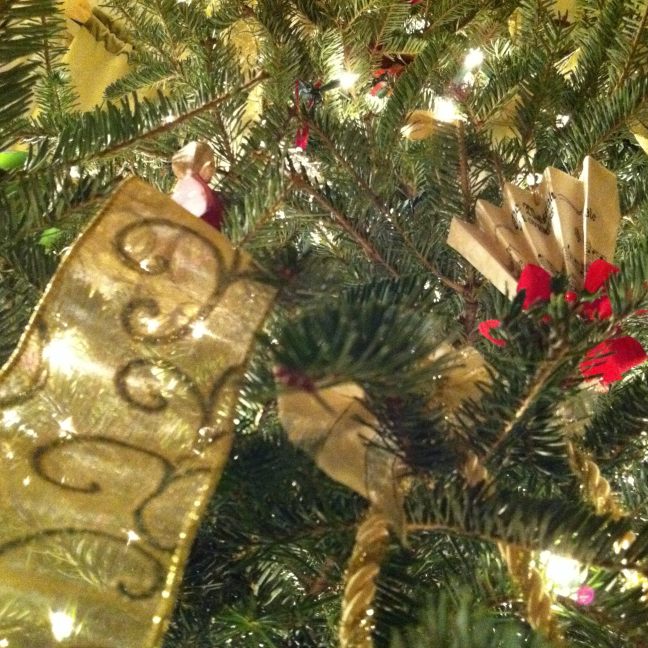
It’s been far too long since my last post, and I apologize for that, dear readers. On December 17, we left Paris for the United States to spend Christmas in South Carolina, a trip I’ve nicknamed a “Fried Green Christmas” in homage to my mother‘s Southern cuisine. Since arriving last Saturday, we’ve decorated the Christmas tree and put up Christmas lights, we’ve visited family and friends in Columbia (spending an hour driving through a Christmas-light installation in a 400-acre park), we’ve spent a jam-packed 24 hours with my parents sightseeing in almost-tropical Charleston, surrounded by Christmas lights in palmetto trees, and we’ve finally finished up our Christmas shopping and gift wrapping.
Today, we’ll be joined by my aunt and uncle for Christmas dinner. There will be 6 of us at the table, but only 4 carnivores. Nevertheless, my mother has cooked a 7-lb. Christmas ham (you know, the one decorated with pineapple rings, maraschino cherries, and cloves), and 3 … yes, count ’em … 3 small chickens! That, along with the best carrot cake I’ve ever tasted, means we’re well on our way to packing on a few pounds before those New Year’s resolutions next weekend! Continue reading Fried Green Christmas
I’m often asked if it’s hard being a vegetarian in Paris. The question makes a lot of sense. After all, when you think of French cuisine, you probably conjure up images of bœuf bourguignon, coq au vin, foie gras, even escargots. And ham, well, ham is practically its own food group here. The truth is, though, that between cheese crêpes and savory tarts (as long as there are no lardons in there), I’ve never really had much trouble finding something to eat. But one of the best things about being a vegetarian in Paris isn’t even French …
… And sorry I could not travel both / And be one traveler …”
— “The Road Not Taken” by Robert Frost
“But, what does Robert Frost have to do with your life in France?” you’re probably wondering. “Shouldn’t you be citing Verlaine or Prévert or somebody else with a French name?”
Well, as a matter of fact, I should be. Just last Thursday, Monsieur Carlier, my French teacher at CCFS, encouraged us all to recite “L’Albatros” by the French poet Charles Baudelaire … or at least some part of it. It is, after all, the first poem that we’ve studied this semester. In the alternative, however—knowing that most of us wouldn’t be able to recite a French sonnet, whether out of timidity or just sheer laziness—we could recite something in our native language. This was a French class, though, so we would have to explain (in French, of course) the meaning of that incomprehensible barrage of foreign words, be they Russian, Japanese … or English. Continue reading “Two roads diverged in a yellow wood …










 je parle américain