It’s been far too long since my last post, and I apologize for that, dear readers. On December 17, we left Paris for the United States to spend Christmas in South Carolina, a trip I’ve nicknamed a “Fried Green Christmas” in homage to my mother‘s Southern cuisine. Since arriving last Saturday, we’ve decorated the Christmas tree and put up Christmas lights, we’ve visited family and friends in Columbia (spending an hour driving through a Christmas-light installation in a 400-acre park), we’ve spent a jam-packed 24 hours with my parents sightseeing in almost-tropical Charleston, surrounded by Christmas lights in palmetto trees, and we’ve finally finished up our Christmas shopping and gift wrapping.
Today, we’ll be joined by my aunt and uncle for Christmas dinner. There will be 6 of us at the table, but only 4 carnivores. Nevertheless, my mother has cooked a 7-lb. Christmas ham (you know, the one decorated with pineapple rings, maraschino cherries, and cloves), and 3 … yes, count ’em … 3 small chickens! That, along with the best carrot cake I’ve ever tasted, means we’re well on our way to packing on a few pounds before those New Year’s resolutions next weekend! Continue reading Fried Green Christmas
One of the great benefits of living in France is the socialized health care system. One of the great headaches of moving to France is the initial application process for it. My story (and, believe me, there is one) is just too exhausting and too long to recount in this post, so suffice it to say that I eventually got what I needed: Couverture Maladie Universelle (“CMU”), complete with my very own French social security number printed on a Carte Vitale. Until the end of November, my CMU was even “complémentaire” because my income was low enough in 2010 to qualify for coverage without any out-of-pocket fees. Vive le socialisme français! You might think that with that kind of coverage, I’d have used my CMU whenever I had a stuffy nose, but I didn’t. In fact, the first time I ever used it was just a few weeks ago, when I needed to get a cavity filled.
That experience can best be described as “factory dentistry“: intake at a big dental clinic without an appointment, lots of waiting, sixteen … count ’em SIXTEEN … bitewing x-rays plus a 360º head scan, followed by quick, no-nonsense filling of that little hole in my molar. After all of that, I walked out without paying for a single thing. I can’t complain about that. So, when I went for a dermatology appointment yesterday evening, I was expecting something similar … but that’s not at all what I got.
My appointment was at 5:30 pm, and I was running late because of a problem in the Métro. I asked Michel to call the office to let them know I was on my way; I didn’t want the dermatologist to pack up and go home before I could get there. Once I got off the Métro, it was relatively easy to find the address. I hurried past several medical offices en route so it seemed I was in the right neighborhood, but once I arrived I started to have doubts.
The office was located on the first floor of a poorly-lit, high-rise apartment building. Now, there’s nothing really out of the ordinary in that. After all, my dentist back in DC had the same kind of office arrangement. What was out of the ordinary was that I couldn’t find the office once I got inside the building. I walked back and forth along the first floor corridor searching for a little plaque with the doctor’s name … something … anything to distinguish her office from the rest of the doors that obviously led to residential apartments. Finally, after a few passes, I located it: the dermatologist’s name scribbled by hand on a tiny sticker (the kind you’d put on the tab of a file folder) just above the doorbell.
“Okay, that’s a little odd,” I thought.
I rang the doorbell and waited. The door opened halfway, and I was greeted by the visage of a short, frizzy-haired woman in a white doctor’s coat peering at me almost suspiciously from inside.
Good evening.
Good evening. I have an appointment at 5:30.
Your name?
Samuel Bell.
Come in.
“Okay, that’s a little odd,” I thought again.
When she opened the door, I caught my first glimpse of the waiting “room.” Frankly, it was more like a waiting “closet” … maybe 72 square feet … already occupied by 2 adults and 2 kids. I made my way over to the corner, sat down in the only available seat, and looked around: four dingy walls and four doors, each (except for the door through which I had come) marked with a hand-written sign denoting what lay behind it. I could hear the doctor with her patient behind the sliding door to the “examination room.” There were at least two more patients ahead of me, it seemed, so this was going to be a long wait, and for what, I was not quite sure.
After about 20 minutes, feeling ill at ease, I started searching for an excuse to leave … and then I found it. In her typical professional manner, the dermatologist had taped a handwritten notice to the wall. Just below the request to turn off our cell phones were the magic words:
Bank cards not accepted. Please pay the exact amount. Cartes Vitales not accepted (only CMU sheets).
I had no idea what a CMU sheet was, but as far as I was concerned, any dermatologist who couldn’t swipe my Carte Vitale and wanted payment in cash wouldn’t be curing my acne! I packed up my things and left, shaking my head.
All that’s to say that I’m still looking for the right dermatologist in Paris, preferably one whose office doesn’t evoke some underground medical operation. I won’t even mind if what I get is “factory dermatology” as long as I’m not hanging out in someone’s apartment and paying cash under the kitchen table.
When I moved to Paris sixteen months ago, I had what I thought was a pretty good plan: 20 hours a week as a French student and 20 hours a week as an English teacher. After all, I had always been attracted to the idea of teaching, even though I had never pursued it as a career. “Why not try it now?” I thought. “This is the perfect time, and this is the perfect place to start.” I had been assured that teaching English was the “easiest field to get into here” and, as an overeducated former lawyer, I thought I had a pretty impressive résumé.
As it turns out, it wasn’t going to be that easy. The truth of the matter is that native English speakers are a dime a dozen in this city, and most good teaching positions require a certification that I don’t have. The disappointment of discovering that I wasn’t a ready-made English teacher plus the demands of my own French classes ended up putting my plan on the back burner … that is, until I recently looked at my bank account and decided that it was high time to turn the heat up again. Continue reading I SPEAK American, but I TEACH English.
I’m often asked if it’s hard being a vegetarian in Paris. The question makes a lot of sense. After all, when you think of French cuisine, you probably conjure up images of bœuf bourguignon, coq au vin, foie gras, even escargots. And ham, well, ham is practically its own food group here. The truth is, though, that between cheese crêpes and savory tarts (as long as there are no lardons in there), I’ve never really had much trouble finding something to eat. But one of the best things about being a vegetarian in Paris isn’t even French …
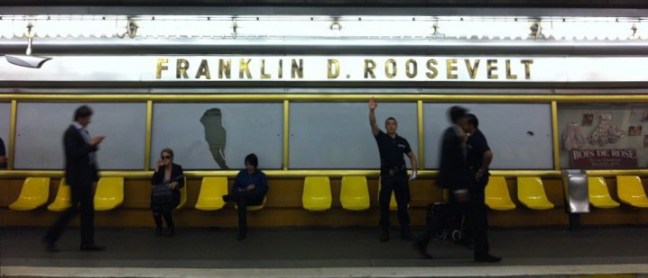
There’s something quintessentially Parisian about the Paris Métro. From the art nouveau entrances to the winding corridors to the white-tiled walls and ceilings, there’s simply no confusing the Paris Métro with any other underground transit system in the world. But did you know how American a few of the Métro stations are? For most French, these stations are probably no more interesting than, say, Boucicaut or Bréguet Sabin, but for an American, they’re little souvenirs of home right here in Paris. Continue reading An American in the Métro
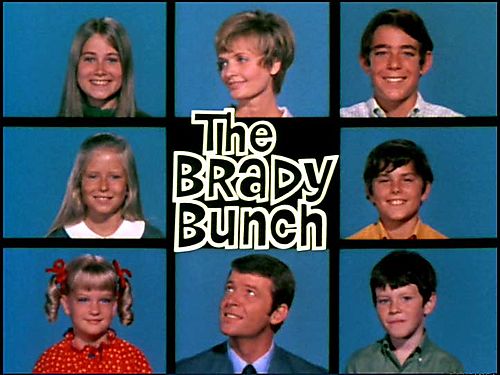
One of the most charming things about French family life is the way one expresses both the “step” and “in-law” relationships. In English, we use the prefix “step” to denote that a relationship has been created by the marriage or coupling of a new, non-biologically-related person with one’s parent. For example, your stepfather is the man who marries or co-habits with your mother after the end of her relationship with your father. Stepbrothers and stepsisters are pre-existing children that come into the family because of this new couple. Think of The Brady Bunch: Mike was Marcia, Jan, and Cindy’s stepfather; Carol was Greg, Peter, and Bobby’s stepmother; the girls were the boys’ stepsisters; and the boys were the girls’ stepbrothers. Conceivably, one could extend the prefix to other family members, as well. We use the suffix “-in-law,” however, to describe the relatives of one’s spouse. For example, your father-in-law is the father of your husband, and your sister-in-law is his sister. Again, one could use the suffix for extended family members as well.
It’s been a week since my last post, and I apologize for the delay in posting something new. It’s been a very hectic and discombobu-lating 7 days.
Right after my last post, we traveled from balmy and sunny South Carolina to cold and drizzly Washington, D.C., to visit friends and ready my apartment there for a tenant. Being face-to-face with my good friends after such a long separation was like a homecoming for me. These little visits (my second one to Washington since leaving last August) remind me of how much I miss that city and the life I built there: my apartment, my church, my circle of friends … but being there this time with Michel also reminded me that my home is wherever I’m with him, whether that’s in Washington, in South Carolina, or in La Courneuve.
Today was September 29: Michaelmas, or the Feast of Saint Michael. In America, we don’t generally make a big deal about the feast days of saints. There are exceptions, of course, the most well-known in America being Saint Patrick’s Day, when we wear green and get drunk, all while pretending to be Irish … and perhaps the Feast of Saint Francis, when you might take your pooch to church for a blessing even if you haven’t darkened the church door for a few months. It was not until I met my French husband, though, that I realized how feast days are still very current in the French consciousness, even if they have largely—if not entirely—lost their religious connotation. As soon I had a few French friends on Facebook, I started to see “bonne fête” popping up in my newsfeed—not thanking someone for a great party the night before, but sending good wishes on the feast day of the Saint that bears his or her name. It’s a nice tradition, and one that I’ve adopted with my French family and friends.
It was the first time that my husband and I had traveled across the Atlantic together: US Airways 787 from Paris-Charles de Gaulle to Charlotte Douglas International on Saturday. Michel has visited me in the United States before, of course: the first time was in December 2009 to meet my friends and family, and the second time was in July 2010, when we got married before my departure for France. But Saturday was a particularly interesting travel day: Jean Reno and a jackass immigrant officer at CDG, an obnoxious flight attendant with an apple and a pear, and a surprisingly warm welcome at immigration control in Charlotte. Continue reading Jean Reno, apples & pears, and my French husband
Okay, I admit it. I’m rapidly becoming a grumpy old man and there’s no use denying it. Michel has even called me “grumshy” — a word he apparently coined as a hybrid of “grouchy” and “grumpy” while searching for one of those two words but failing to find either one. And he’s right. I’ve found that the older I get and the longer I stay in France (two things that are coincidental at the moment), the less I can stand sustained buzzing, screeching, whining, high-pitched noises.












 je parle américain