“The Pain of the Country”

Tomorrow is September 11, but this blogpost won’t focus on the tragedy of that day 10 years ago that will forever mark me and those who witnessed or were personally touched by the events and their aftermath. I could never do it justice—I could never adequately put my sentiments into words. Silent reflection is how I plan to mark this somber moment tomorrow.

But this anniversary necessarily brings home to mind. Being a stranger in a strange land is never an easy thing, and at moments like this, the disconnectedness is amplified, the distance is more expansive, the ache to go back is more painful. The French have an interesting expression for what we call homesickness. They call it le mal du pays (literally, “the pain of the country”) and, somehow, it seems appropriate this weekend to speak of a yearning for something much larger than even my family and friends—a yearning for my home … my homeland … my country.


Continue reading “The Pain of the Country”

Carrot Cake!

Photo: the ingredient that makes it what it is © 2011 Samuel Michael Bell, all rights reserved

Yesterday, we went for a long walk in the countryside with the kids. We searched out the neighborhood farm, where we saw THREE TRACTORS and smelled COW MANURE! Then we walked out into the fields and saw a DUST DEVIL and got shocked by an ELECTRIFIED LIVESTOCK FENCE! It was a big day! So what could the uncles think up to top a day like that?

The answer?

CARROT CAKE!

This morning, we told the kids that our project for the day would be to make very special American cake: a gâteau aux carottes.

Carrots?! Carrots in a cake?! Ugh.

Well, yes. There are little pieces of carrot in the cake but there’s no carrot taste. Tonton Michael doesn’t even like carrots. There are little pieces of nuts, too. You’ll see! It’s good.

I don’t like nuts.

Tough crowd.

Continue reading Carrot Cake!

Tonton Michael

Photo: “Buzz l’Éclair” © 2011 Samuel Michael Bell, all rights reserved

This week, I’m in Doncourt-lès-Conflans, a village in the countryside of Lorraine, just west of Metz. Michel and I are babysitting our niece and nephew, Tiphaine and Romain. They’re the ones I referenced in this post about a child’s imagination … or was it about my rusty drawing skills? In any case, vacation is over for their parents, but school doesn’t start back for them until next week, so it’s Tonton Miko (that’s Michel) and Tonton Michael (that’s me) to the rescue!

Continue reading Tonton Michael

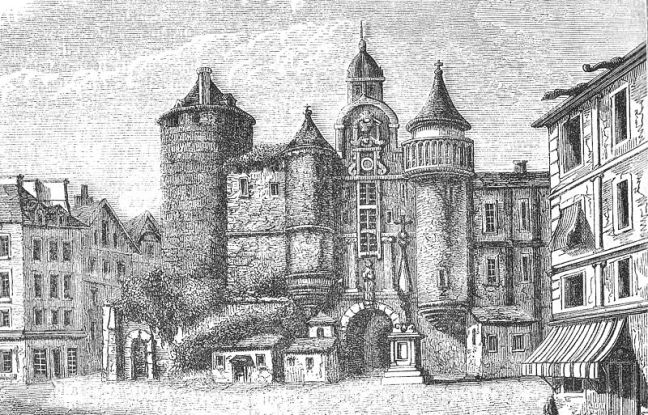
Châtelet-Les Halles

Photo: Le Grand Châtelet after 1684

Châtelet-Les Halles is not only located at the very geographic center of Paris, it is also the transit hub of the city. It is actually a complex of two Métro stations (Châtelet and Les Halles) and a pôle d’échange, or central exchange station, for the RER (Réseau Express Régional or Regional Express Network, Paris’s commuter light rail system). The RER station services three of Paris’s 5 RER lines: A, B, and D. Métro station Châtelet services 5 of Paris’s 16 Métro lines: 1, 4, 7, 11, and 14. Métro station Les Halles services the 4 line.

The first notable thing about Châtelet-Les Halles is that it’s huge! The southern end of the RER station connects to the Châtelet Métro station and the northern end connects to the Les Halles Métro station. The walking distance from Châtelet to Les Halles is almost half a mile (750 meters)—a distance 50% longer than the average distance between stations in the Paris Métro system! Thankfully the transfer is facilitated at one point by a nice, long people-moving conveyor belt … or you can just take the 4 line and save the shoe leather.

The second notable thing about Châtelet-Les Halles is that it is the busiest underground transit station in the world. Each weekday, Châtelet-Les Halles hosts about 750,000 travelers (more than the average weekday traffic in the entire Washington, DC Metro). During rush hour, 120 trains arrive in and depart from Châtelet-Les Halles each hour! That’s a lot of people scurrying here and there. No wonder Châtelet-Les Halles is, in my opinion, the most overwhelming and disorienting Métro station in Paris.

So, the question that I initially set out to answer: why is it called Châtelet-Les Halles?

Read the rest of this entry for the interesting, in-depth backstory »

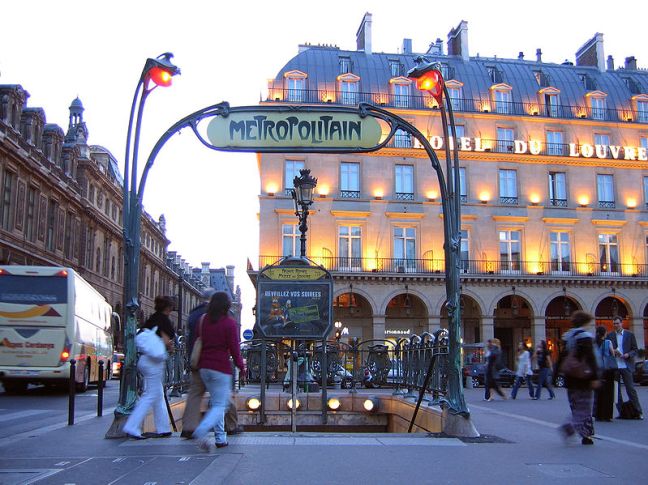
Le Métro

Photo: © Simon Law

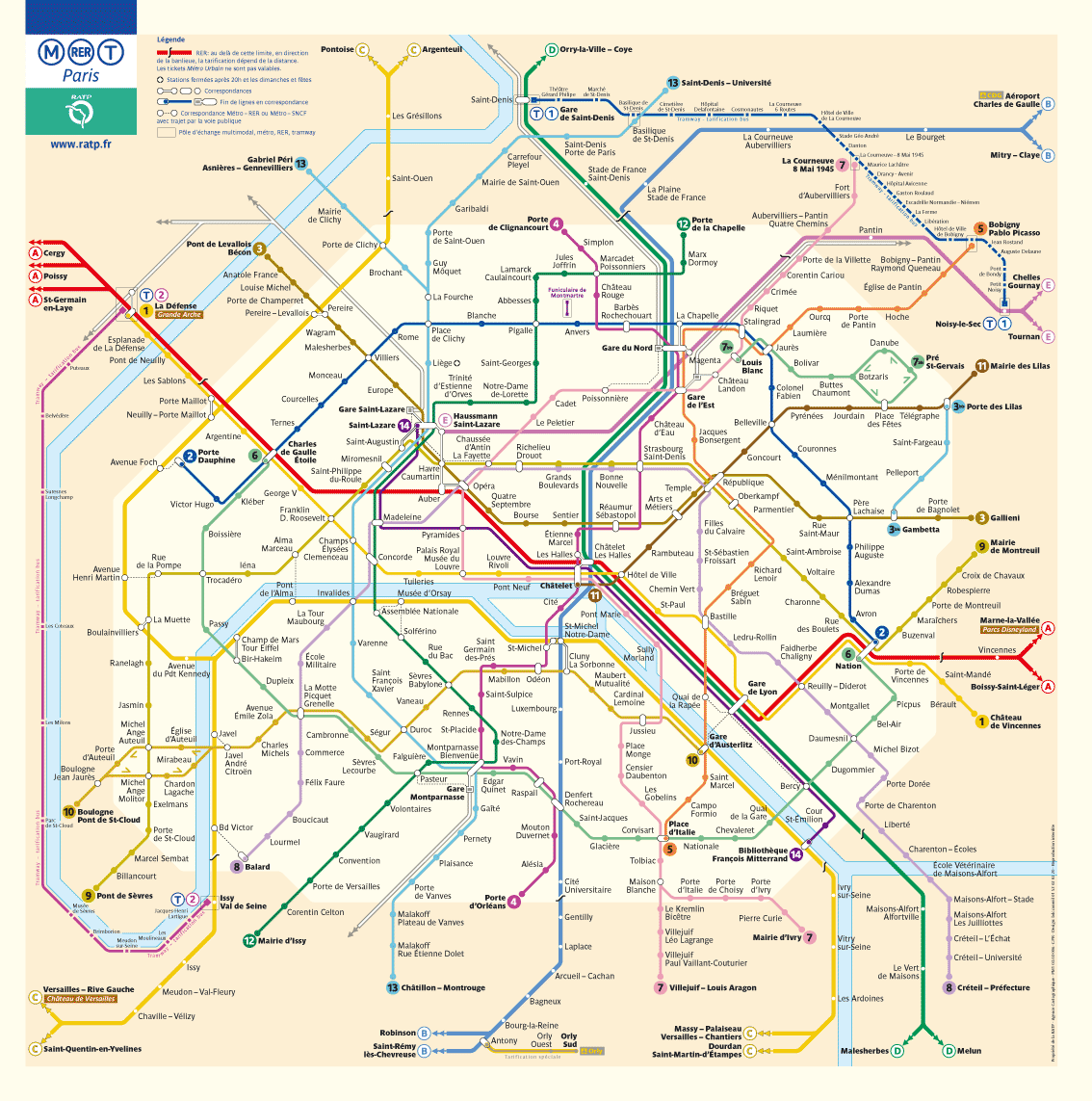
If you’ve ever spent much time in Paris, you know that the Paris Métro is enormous: 16 lines, 381 stops in 297 stations (of which 62 provide correspondence between lines), and 132 miles of routes. It’s not as large as New York’s subway system, of course, which has 24 lines, 468 stops in 421 stations, and 209 miles of routes, but it is much bigger than the Metro system of my hometown of Washington, DC: the DC Metro has 5 lines, 118 stops in 86 stations, and 106 miles of routes.

© RATP — The Paris Métro is enormous.

Paris’s Métro is one of the densest subway systems in the world, with 245 of its stations located within the 34 square miles of the city of Paris itself. Since the Métro was designed at the end of the nineteenth century to comprehensively serve the city, the stations are very close together: only 548 meters apart on average (about a third of a mile or 600 yards), ranging down to 424 meters (a quarter of a mile or 465 yards) on line 4 and up to one kilometer (about six tenths of a mile or 1,100 yards) on the newest line 14. With all these Métro stations and their maze-like transfer tunnels, it’s no wonder that Paris has been described as a véritable gruyère. 

Continue reading Le Métro

Protected: The Patience of a Butterfly

This content is password-protected. To view it, please enter the password below.

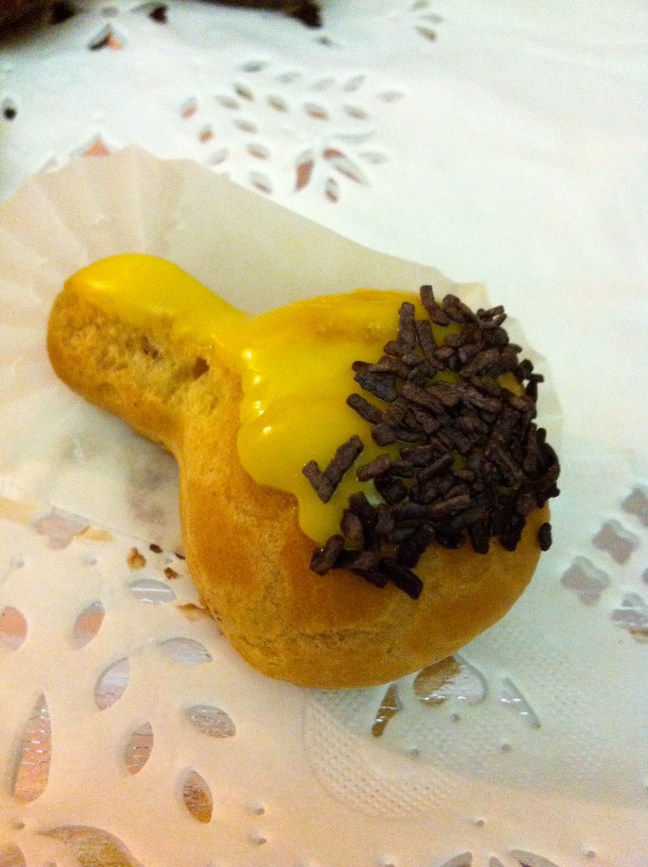
Le Gland

Photo: a mini gland © 2011 Samuel Michael Bell, all rights reserved

Leave it to the French to create a pastry called “the Gland.” Sounds a little strange in English, right, but what does it mean in French? Well, it means “acorn.” It can also mean something else a little less arboreal and more anatomical … but I’m not going there. I’ll let you do it: Google Translate.

Read the rest of this entry »