“Aux urnes, citoyens!” • “To the ballot boxes, citizens!”

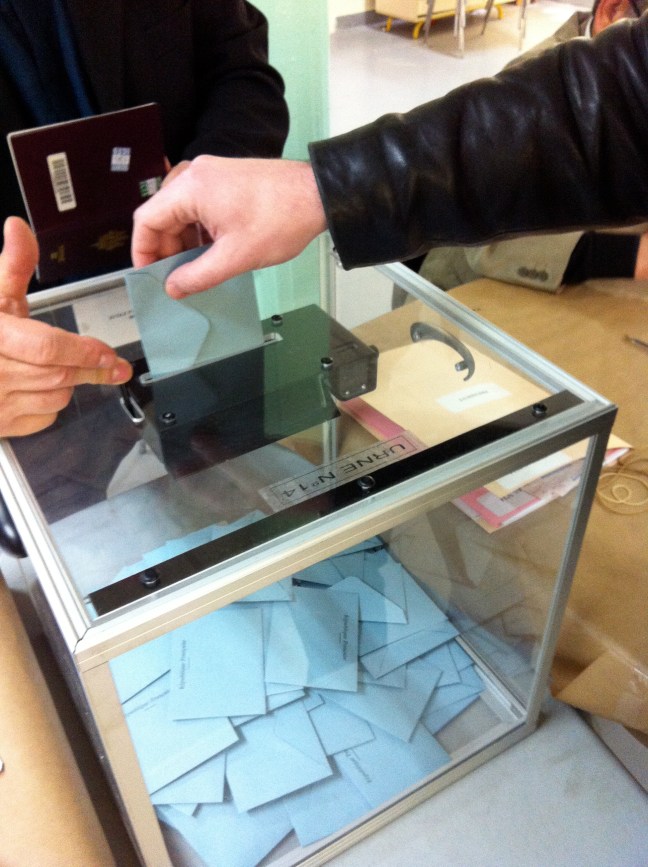
Today, like some kind of United Nations election observer (or a self-appointed election journalist for the online media), I witnessed my first foreign election in progress. April 22, 2012 : It’s the first round of the French presidential elections, and I tagged along as Michel went to his polling place and exercised his franchise. It was a proud moment for him and for me. It was even memorialized on Facebook. Here’s the picture …
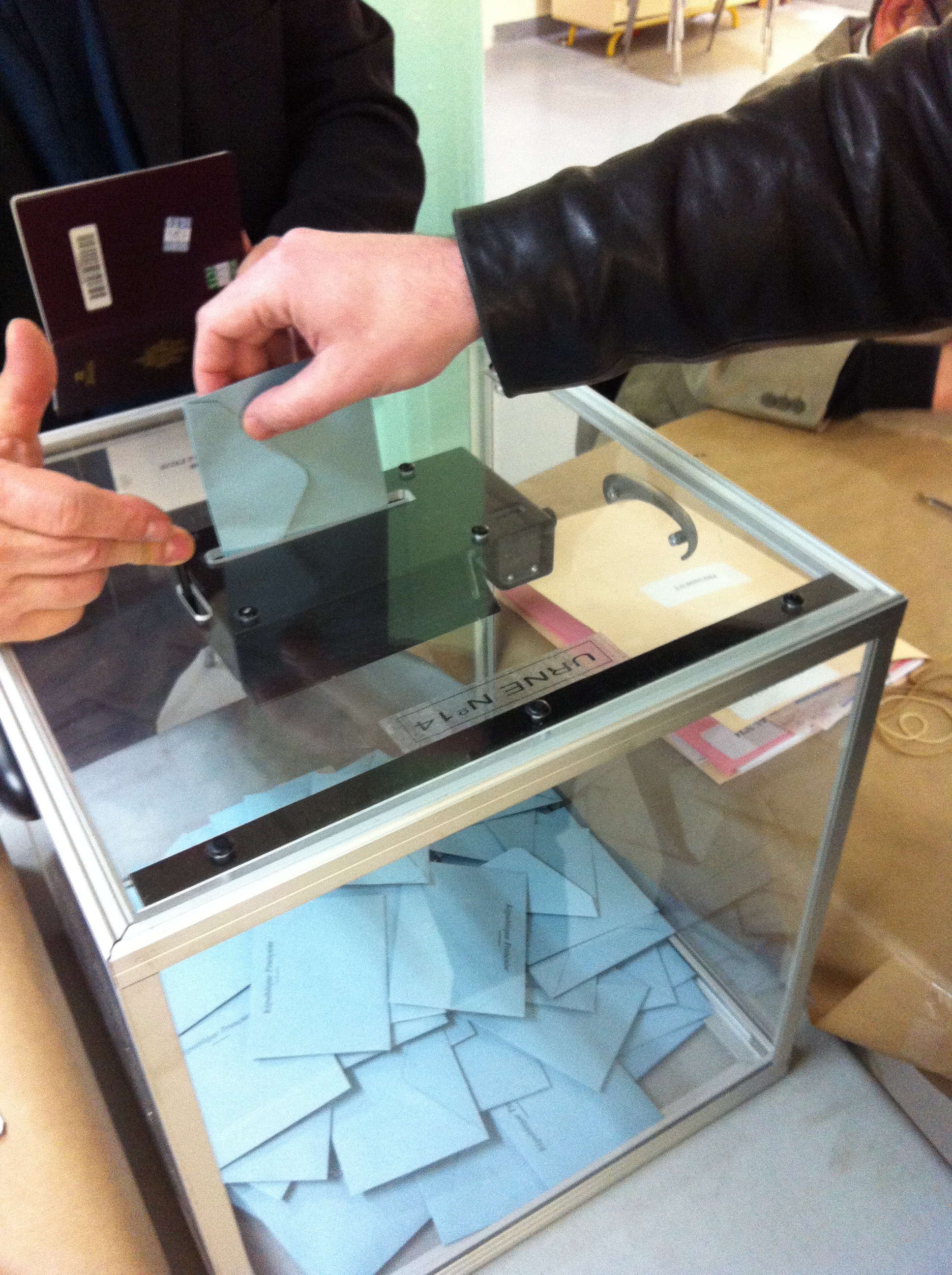
“Michel Denis Pouradier … a voté.” • “Michel Denis Pouradier … has voted.” © 2012 Samuel Michael Bell, all rights reserved

As an American — coming from a tradition that likes to view of itself as the father (even the guarantor) of democracy around the world — I found it very intriguing to watch the voting process here. As in America, the voting system differs from town to town, but here in La Courneuve, they still use paper ballots and ballot boxes (“urnes“). That struck me as both surprisingly outmoded and, somehow, so much more legitimate than pressing buttons on a touchscreen and watching your vote disappear into the ether. Watching Michel vote brought to mind images of elections in less developed countries that we Americans often see on our evening news, but also memories of my childhood, accompanying my parents to their polling place in rural South Carolina where, after having voted, they dropped their ballots in a little locked wooden box with a slot in the top. Nostalgia. Continue reading “Aux urnes, citoyens!” • “To the ballot boxes, citizens!”

French Carolina

Carolina was an English colony, of course, but did you know that the French actually beat the English in the race to get there? Of course, the Spanish beat them all in 1526. Quelle surprise. Their settlement, San Miguel de Gualdape, was actually the first European settlement in what is now the United States, possibly located near the site of present-day Georgetown, South Carolina. Unfortunately for the Spanish, though, San Miguel was abandoned after only 3 months when famine, disease, and unrest among their Native American neighbors forced the settlers to return to Santo Domingo. The French arrived in 1562, after Admiral Gaspard de Coligny organized an expedition to settle the region. The expedition, led by Norman navigator Jean Ribault, built Charlesfort on present-day Parris Island but, like the Spanish before them, they didn’t stick it out for very long. Ribault, having returned to Europe for supplies, was detained because of the French wars of religion, leaving his fledgling settlement to founder. After only one year, all but one of the 28 remaining settlers set off across the Atlantic in a makeshift vessel. You may have read about their fate: by the time they were rescued by a passing English ship, the unfortunate crew had already resorted to cannibalism to stay alive as they drifted aimlessly on the ocean. Meanwhile, the Spanish sent an expedition from Cuba to destroy Charlesfort, and the French experiment in colonizing the area came to an end. It wasn’t the end of French settlement though …

Continue reading French Carolina

Mike Bell: Cowboy, Alligator Wrestler

Being an American in France has given me, rightly or wrongly, a certain mystique thanks to the preconceptions of my French family and friends. Some of their preconceptions, of course, are not ones I readily embrace, however true they might be. Others, I tend to play up, however true they might not be. One of those embraceable preconceptions is that I’m some sort of cowboy.

Part of the attraction of “America” for some French people, I think, is the image of the cowboy as an American stereotype. Now, I’m certainly no Marlboro Man and I’d say I’m prone to being booted out of most roadhouses, but I have been on a horse, I have country line danced, and I do walk with a certain thumb-in-pocket swagger, even on the cobblestones of Paris. Growing up in the Deep South — in the country — and speaking with a certain drawl about subjects like hunting, tractors, and country-western music give me a certain “cowboy credibility” here … even though I’m a vegetarian, I’ve only shot my father’s rifle a handful of times, and the most farm work I’ve ever done was picking beans in my parents’ garden. Nevertheless, if they want to see me as a cowboy, I’m more than happy to oblige.

Last week, when I was in South Carolina, my parents and I traveled down to Hilton Head to visit my aunt and uncle. Now, we all know that Hilton Head is not exactly the Okefenokee, but I knew there’d be alligators there and I was anxious to snap a few good shots to impress Michel, who was back in France. The evening after we arrived, my uncle and I went out searching for alligators in the neighborhood and just when we thought there were none to be found, we happened upon a big daddy gator sunning himself on the bank of a pond. Like an American Crocodile Dundee, I sprang into action … Continue reading Mike Bell: Cowboy, Alligator Wrestler

Our Daily Bread

April 2009. The beginning of a great love affair. © 2012 Samuel Michael Bell, all rights reserved

One of my favorite things about living in France is the bread. The French, as you know, have a knack for making great things in the kitchen, and their bread is undoubtedly one of their finest products. I often joke that the reason I’ve gained about 7 kilos (that would be 15 pounds) since the summer of 2009 is the fact that French bread is so readily available. In Paris, you can’t walk for more than 2 or 3 blocks without the scent of freshly baked baguettes enticing you into a boulangerie like some siren song for your waistline.

This is also why I’ve often said that I can’t really eat American bread anymore. My palate has become so snobbish about bread that I even turn my nose up at the creations of the very artisanal American bakeries that I formerly patronized and touted to the world, and I even claim that Le Pain Quotidien just tastes different in America than it does in France. I’ll never forget Michel‘s first visit to Washington back in December 2009, when I went searching for a baguette for dinner, hurrying home with a pain de campagne from my neighborhood bakery because they didn’t have any baguettes, only to blush with embarrassment upon realizing that it simply didn’t measure up to what Michel was used to eating—what I’m now used to eating. That’s why I chose a warm, fresh tradition for my last lunch in France before leaving for the U.S. last weekend. I had to get my fix before starting this two-week sojourn in the land of Merita and Sunbeam, you know. Continue reading Our Daily Bread

The Light at the End of the Tunnel

© Sura Nualpradid

Hey … remember me?

Yeah, it has been a while. I know that I told you I’d try to post something every now and then while slogging through my CELTA training course, but it really hasn’t been an option, guys. I promise.

Here’s a picture of what my average day has been like for the last three weeks:

I wake up around 5 a.m., practicing the day’s lesson plan in my head and obsessing over the gaps that I couldn’t recall during my anxiety-ridden dreams, I try to go back to sleep, and I succeed in dozing until around 7:15 a.m. (or 6:45 a.m. on days when I have teaching practice). Then it’s up and at ’em … I arrive at school some time between 8:15 a.m. and 8:45 a.m., where I print out lesson plans, exercises and materials, or written assignments.

Our instructional sessions start at 9:15 a.m. That’s where we learn about every conceivable facet of teaching methodology (and a bit of English grammar to boot). Then it’s “teaching practice consolidation” from about 12:30 p.m. until about 1:00 p.m., when we review our lesson plans with the other trainees who will be teaching during the same 2-hour class in the afternoon. (Since we have 40-minute lessons each on the days when we teach, there are always two other trainees with whom we have to coordinate our lessons to ensure that the afternoon is a cohesive and productive experience for the students.) Then comes lunch, but I don’t really eat much, because I’m usually spending that hour or so revising my lesson plan, making last-minute changes to the materials, and nervously anticipating my lesson. Then it’s show time—a two-hour lesson for a class of anywhere from four to ten EFL students!

Continue reading The Light at the End of the Tunnel

Can I sleep now?

Well, everyone, today marks the end of my first week of intensive training to become a teacher of English to speakers of other languages. That’s 5 days down and 21 to go. I don’t have much time to indulge in the leisurely activity of blogging at the moment, so I’ll just share an edited Facebook status I posted this evening when I first got home. I think it sums up the first week pretty nicely.

  • I’m exhausted! In the last two nights, I’ve slept a total of 9 hours. I don’t expect this to get much better any time soon, either. Methodology and language analysis sessions every morning + teaching practice or observation every afternoon + 4 or 5 hours of lesson planning or homework every night = a hard row to hoe.
  • Writing lesson plans is truly an art … and a time-consuming one at that. Thank all the good teachers in your life for putting the effort into making good plans for what they taught you. Most of us have no idea how much thought and work go into that. That’s probably because the best teachers just make it look so easy.
  • My first lesson to a group of real, live students was on Tuesday afternoon. It went really well even though I was nervous enough to feel like throwing up for two hours before it even started. My second lesson on Thursday was personally disappointing. I felt extremely stressed because of last-minute changes to the lesson plan. According to my evaluator, though, it went well. Today’s lesson, on the other hand, was nothing short of a disaster. I tried to accomplish too much, and my instructions weren’t clear enough or adequately reinforced. My evaluator didn’t argue with my self-assessment, but at least I didn’t get raked over the coals. Instead, she pointed out my strengths and was glad to see that I immediately recognized the areas where I overstretched. Maybe it’s a training rule not to crush your spirit at the outset? (By the way, “freer stage” lessons—for anyone who’s familiar with the concept—are not as easy as they seem.) Continue reading Can I sleep now?

Truffles: mushrooms, chocolate, and … dogs?

For the last post before my CELTA English teaching course begins Monday, I thought I’d write about a few relevant “French English” words : student, study, review, professor. Then a friend shared an interesting article with me, and I decided to go with truffle instead—probably more engaging and certainly more enticing than a discussion about homework!

Truffle has two very distinct meanings in English, of course. It can refer to the very tasty and very expensive mushroom that grows in forests between the leaf litter and the soil and gets sniffed out by special truffle-hunting pigs and dogs. If you have a sweet tooth like me, though, the word probably initially conjures up images of those decadent little chocolate confections.

The word truffle (or “truffe” in Modern French) comes from the Old French “trufe” by way of the Old Provençal “trufa,” which itself comes from the Vulgar Latin “tufera“—a dialectal variant of the Latin “tuber,” meaning “lump.”

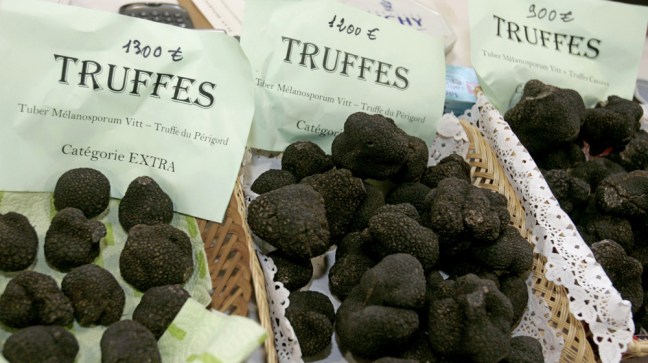
black Périgord truffles © 2012 Reuters
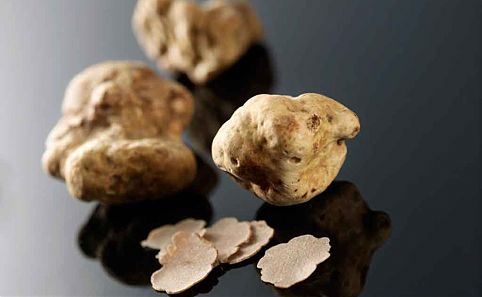
Italian white truffles

When you look at a truffle of the fungal variety, you can certainly see why it takes its name from the Latin word for lump. It’s definitely not a pretty thing, but the taste … well, it’s simply amazing. There is a reason, after all, why the black Périgord sells for as much as $800 a pound and the white variety sells for as much as $2,000 a pound! Continue reading Truffles: mushrooms, chocolate, and … dogs?

It’s bissextile …

Monday afternoon, I realized something fairly mundane but nonetheless rare: it was Leap Year and today was going to be Leap Day. Sitting at my desk, I turned to Michel and I started to tell him that (in French, because we almost always speak in French now), but I stopped short when I couldn’t find the word …

“Hé, Michel. Mercredi, on sera le jour de … euh … c’est le …
tu sais … le 29 février. Comment on dit ça en français?”
“Hey, Michel. Wednesday is the day of … um … it’s the …
you know … the 29th of February. How do you say that in French?”

“Oh, c’est la bissextile.”
“Oh, it’s the bissextile.”

<one raised eyebrow>

“Euh, la quoi?”
“Uh, the what?”

After my brain had a few seconds to parce the word and realize it had nothing to do with what I thought I’d heard, I started to wonder how the French came up with the name. It didn’t seem to have anything at all to do with leaping, or jumping, or hopping …

As usual, I did a little low-level research (meaning lots of Wikipedia articles). Michel was actually using the French adjective describing Leap Year. The adjective bissextile and the far less common noun for Leap Day, bissexte, come from the Latin word for the extra day in a Leap Year : bisextus, which itself is formed from bis (twice, second) plus sextus (the sixth). Okay, but why bisextus … why “the second sixth”?

Continue reading It’s bissextile …

The Hedgehog

Sometimes, I run out of witty observations about life in France and I get the feeling that it might be too soon for yet another “interesting” etymological history. Today is one of those days, so I asked myself, “Why not give them a recommendation on something French?” Not a bad idea. So here goes …

I strongly encourage you to run to your local movie store, add to your Netflix queue, or somehow stream to your computer :

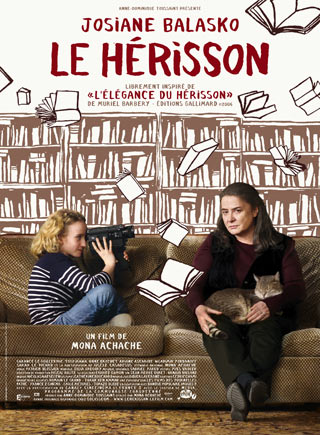
Le Hérisson
(The Hedgehog)

I first saw Le Hérisson about a year ago, and it ranks as one of my favorite French movies of all time, along with Le fabuleux destin d’Amélie PoulainLe premier jour du reste de ta vieUn long dimanche de fiançailles (even though I still haven’t seen the end), and La Reine Margot (because, yes, I am a history nerd in addition to being a hopeless romantic, and I embrace that).

Le Hérisson is director Mona Achache‘s adaptation of Muriel Barbery‘s novel L’Élégance du hérisson (The Elegance of the Hedgehog). It’s the story of unexpected connections among the most unlikely of friends: Madame Renée Michel, the  grumpy (and frumpy) 54-year-old concierge of an upper-class Paris apartment building; Paloma Josse, an eleven-year-old resident and amateur nihilist philosopher; and Monsieur Kakuro Ozu, the enigmatic new resident of the building.

Continue reading The Hedgehog

Laissez les bons temps rouler!

About a week ago, I stumbled upon Tremé, an HBO series set in New Orleans after Hurricane Katrina. It’s the story of several New Orleanians struggling to rebuild their lives after the catastrophe. On a grander scale, it paints a poignant picture of a unique culture determined to preserve itself against the odds. In a few days’ time, I had already watched the entire first season; I hadn’t felt such an immediate attraction to a television series in a very long time, and I simply couldn’t stop watching it. The music and the scenery brought back memories of my first and only visit to New Orleans a few years after the hurricane, and I decided that I needed to see it again one day and show its magic to Michel.

© Home Box Office, Inc.

And, of course, all this happened in the days leading right up to Mardi Gras.

Mardi Gras, meaning “Fat Tuesday,” is a Christian holiday marking the end of the season of Epiphany and the beginning of the season of self-sacrifice called Lent (or Carême, in French). It’s the culmination of Carnival season, when you’re expected to indulge (notably in fatty foods—hence the name) in advance of the solemn season that follows. If you’ve ever been to New Orleans—whether at Carnival season or even in November—you know that no one does decadence quite like the Crescent City : think shrimp po’ boys and spicy gumbo, warm beignets dusted with powdered sugar at Café du Monde, and Hurricanes in go-cups.

But why does New Orleans indulge so well? Perhaps it’s because the city can trace its very origins—however tenuously—back to Mardi Gras :

Continue reading Laissez les bons temps rouler!