Good Feast!

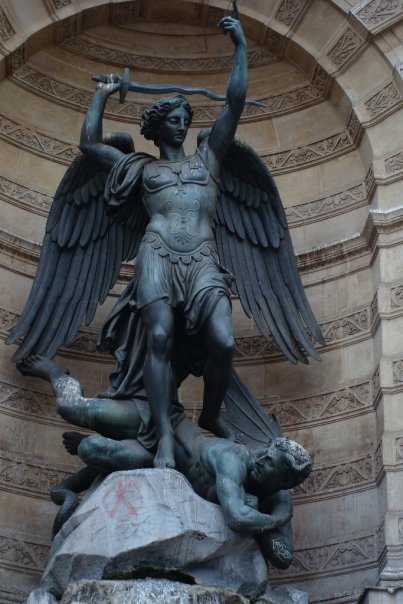
Today was September 29: Michaelmas, or the Feast of Saint Michael. In America, we don’t generally make a big deal about the feast days of saints. There are exceptions, of course, the most well-known in America being Saint Patrick’s Day, when we wear green and get drunk, all while pretending to be Irish … and perhaps the Feast of Saint Francis, when you might take your pooch to church for a blessing even if you haven’t darkened the church door for a few months. It was not until I met my French husband, though, that  I realized how feast days are still very current in the French consciousness, even if they have largely—if not entirely—lost their religious connotation. As soon I had a few French friends on Facebook, I started to see “bonne fête” popping up in my newsfeed—not thanking someone for a great party the night before, but sending good wishes on the feast day of the Saint that bears his or her name. It’s a nice tradition, and one that I’ve adopted with my French family and friends.

Continue reading Good Feast!

A Walk in the Woods

“The clearest way into the universe is through a forest wilderness.” — John Muir

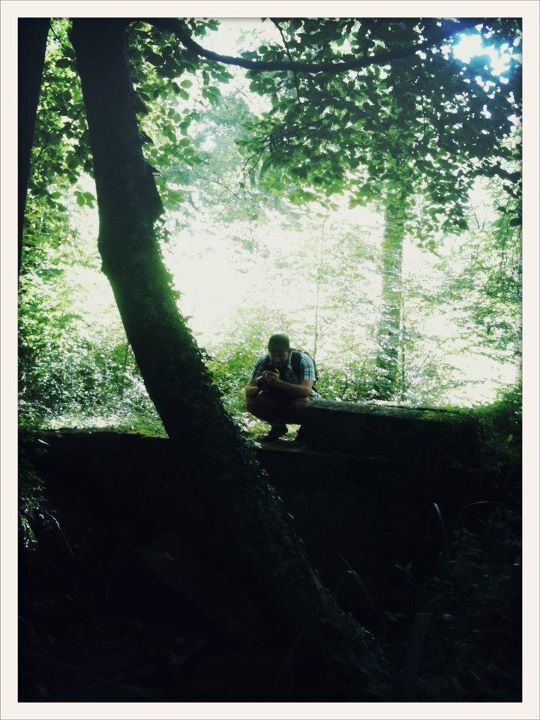
Last week, I went with Michel, my mother-in-law, and my father-in-law for a walk in the woods—not in La Courneuve, certainly, and not even in the woods close to Paris (the Bois de Boulogne or the Bois de Vincennes), but in Picardy, about an hour to the north. There’s a trail in the Forest of Compiègne near the village of Saint-Jean-aux-Bois that we know and love. It leads you into a world that’s far away, one that’s quiet, peaceful, and full of simple wonders.

Continue reading A Walk in the Woods

You don’t say!

Registering for my fall classes this morning got me thinking about what it is that I really love about learning a foreign language. It’s certainly not conjugating the pluperfect of the subjunctive mood! Instead, it’s linguistics and etymology: how we say the things we say, and why it is we say them that way. Today’s musing:

pas

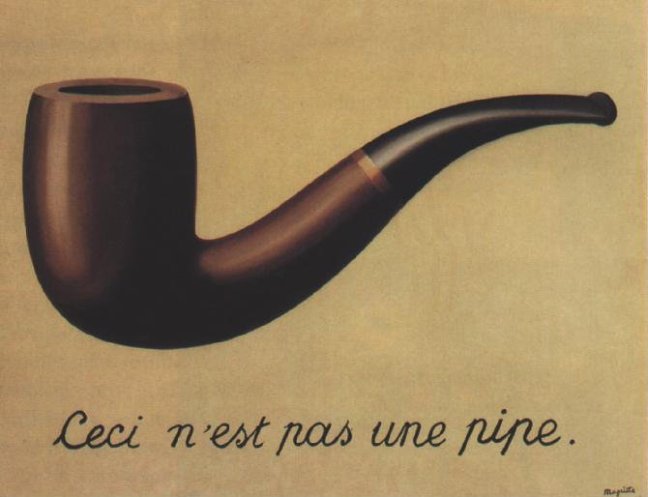
For anyone with even a basic knowledge of French, “pas” is a pretty easy word. It means “not” … right? Well, I’ll get back to that in a minute but, more importantly for now, “pas” also means “step” — as in the motion we make when we place one foot in front of the other. Hence, we have the expression “faux pas” — one that we’ve adopted directly into English — meaning a mistake or, more precisely, a “false step.” So, how exactly did a word that means “step” also come to be the most common word in French to mean “not”?

Continue reading You don’t say!

“The Pain of the Country”

Tomorrow is September 11, but this blogpost won’t focus on the tragedy of that day 10 years ago that will forever mark me and those who witnessed or were personally touched by the events and their aftermath. I could never do it justice—I could never adequately put my sentiments into words. Silent reflection is how I plan to mark this somber moment tomorrow.

But this anniversary necessarily brings home to mind. Being a stranger in a strange land is never an easy thing, and at moments like this, the disconnectedness is amplified, the distance is more expansive, the ache to go back is more painful. The French have an interesting expression for what we call homesickness. They call it le mal du pays (literally, “the pain of the country”) and, somehow, it seems appropriate this weekend to speak of a yearning for something much larger than even my family and friends—a yearning for my home … my homeland … my country.

Continue reading “The Pain of the Country”

Tonton Michael

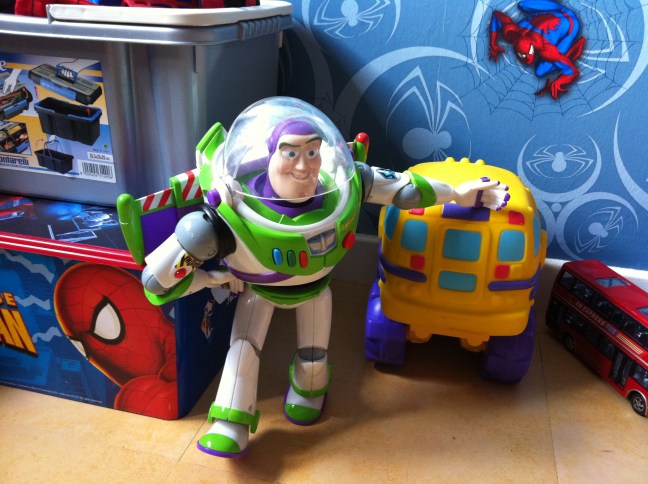
Photo: “Buzz l’Éclair” © 2011 Samuel Michael Bell, all rights reserved

This week, I’m in Doncourt-lès-Conflans, a village in the countryside of Lorraine, just west of Metz. Michel and I are babysitting our niece and nephew, Tiphaine and Romain. They’re the ones I referenced in this post about a child’s imagination … or was it about my rusty drawing skills? In any case, vacation is over for their parents, but school doesn’t start back for them until next week, so it’s Tonton Miko (that’s Michel) and Tonton Michael (that’s me) to the rescue!

Continue reading Tonton Michael

Châtelet-Les Halles

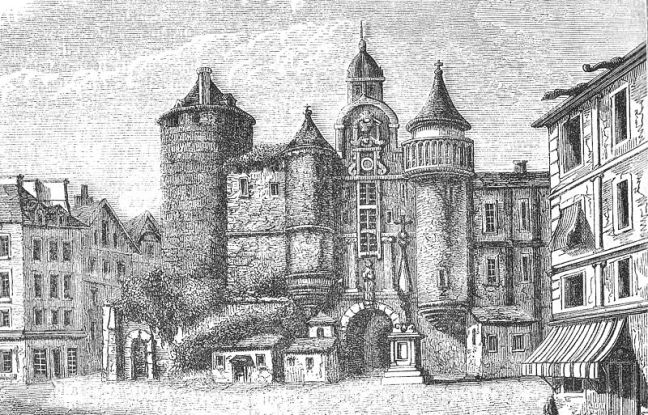
Photo: Le Grand Châtelet after 1684

Châtelet-Les Halles is not only located at the very geographic center of Paris, it is also the transit hub of the city. It is actually a complex of two Métro stations (Châtelet and Les Halles) and a pôle d’échange, or central exchange station, for the RER (Réseau Express Régional or Regional Express Network, Paris’s commuter light rail system). The RER station services three of Paris’s 5 RER lines: A, B, and D. Métro station Châtelet services 5 of Paris’s 16 Métro lines: 1, 4, 7, 11, and 14. Métro station Les Halles services the 4 line.

The first notable thing about Châtelet-Les Halles is that it’s huge! The southern end of the RER station connects to the Châtelet Métro station and the northern end connects to the Les Halles Métro station. The walking distance from Châtelet to Les Halles is almost half a mile (750 meters)—a distance 50% longer than the average distance between stations in the Paris Métro system! Thankfully the transfer is facilitated at one point by a nice, long people-moving conveyor belt … or you can just take the 4 line and save the shoe leather.

The second notable thing about Châtelet-Les Halles is that it is the busiest underground transit station in the world. Each weekday, Châtelet-Les Halles hosts about 750,000 travelers (more than the average weekday traffic in the entire Washington, DC Metro). During rush hour, 120 trains arrive in and depart from Châtelet-Les Halles each hour! That’s a lot of people scurrying here and there. No wonder Châtelet-Les Halles is, in my opinion, the most overwhelming and disorienting Métro station in Paris.

So, the question that I initially set out to answer: why is it called Châtelet-Les Halles?

Read the rest of this entry for the interesting, in-depth backstory »

Le Gland

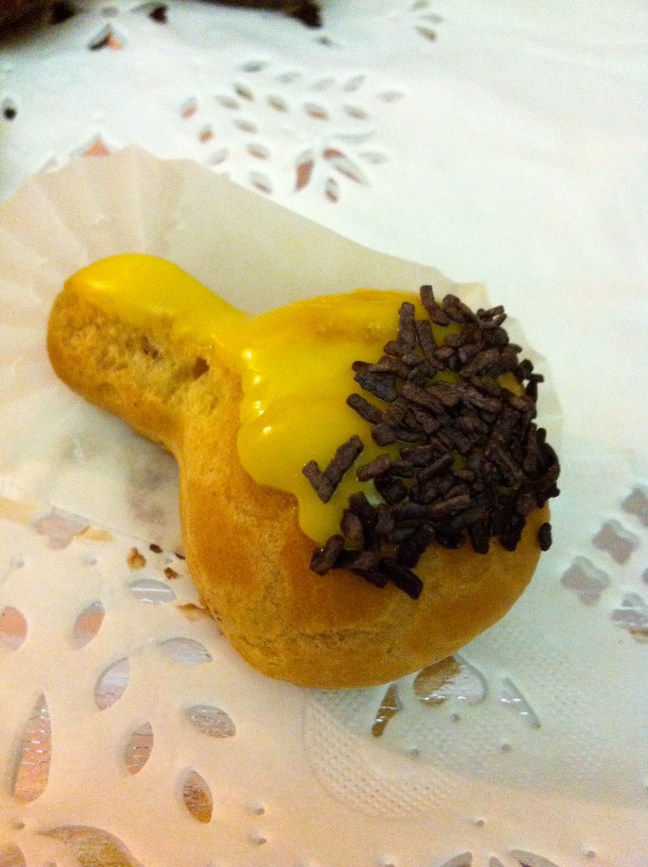
Photo: a mini gland © 2011 Samuel Michael Bell, all rights reserved

Leave it to the French to create a pastry called “the Gland.” Sounds a little strange in English, right, but what does it mean in French? Well, it means “acorn.” It can also mean something else a little less arboreal and more anatomical … but I’m not going there. I’ll let you do it: Google Translate.

Read the rest of this entry »


The Saturation Point … or Drunk Bees

I don’t speak French fluently—not by any stretch of the imagination—but I have spent two semesters in intensive French courses. I graduated from the niveau supérieur in May with a pretty good grade (if I do say so myself), and my French family has even noted how much progress I’ve made in recent months.  Just this weekend, one of my sisters-in-law remarked how much better I now comprehend naturally-spoken French … something about how they don’t have to slow down and talk to me at half-speed anymore.

Nevertheless, if you’ve ever lived abroad while being “short of fluent” in the host country’s language, you know how exhausting it is to be immersed in that language non-stop. The point comes when you just can’t process it anymore. You space out, the words just become background noise, and your brain takes off to another place where everything’s in English. I call it the saturation point, and it happened to me this weekend.

Continue reading The Saturation Point … or Drunk Bees

The French Connection: At Least 0.4%

If you did a keyword analysis of my blog, you might conclude that I’m obsessed with food: cocktails, French pastries, and the search for pancakes in Paris. You might be right. The truth is that I am a gourmand; I can’t deny it. But my real passion — my real obsession — is history.

HISTORY NERD ALERT: If you don’t like history, this may not be your favorite blogpost, but try it out anyway. You might find it interesting. If you’re in my family, you’re going to want to read this regardless of whether you like history, because it’s your story too!

Here we go …

Dubosc • DuBose

I have always loved to immerse myself in old stories and as a child, I often imagined myself in other times, leading a different life in the middle of some historical event   I was reading about. I loved listening to family stories, too, especially those of my Great Aunt Adeline, who could recount the exploits and travails of the family with such color that you had the impression that she was actually there when it all happened. I probably owe my love of history to some combination of Aunt Adeline’s stories and the World Book Encyclopedia.

Continue reading The French Connection: At Least 0.4%