Can I sleep now?

Well, everyone, today marks the end of my first week of intensive training to become a teacher of English to speakers of other languages. That’s 5 days down and 21 to go. I don’t have much time to indulge in the leisurely activity of blogging at the moment, so I’ll just share an edited Facebook status I posted this evening when I first got home. I think it sums up the first week pretty nicely.

  • I’m exhausted! In the last two nights, I’ve slept a total of 9 hours. I don’t expect this to get much better any time soon, either. Methodology and language analysis sessions every morning + teaching practice or observation every afternoon + 4 or 5 hours of lesson planning or homework every night = a hard row to hoe.
  • Writing lesson plans is truly an art … and a time-consuming one at that. Thank all the good teachers in your life for putting the effort into making good plans for what they taught you. Most of us have no idea how much thought and work go into that. That’s probably because the best teachers just make it look so easy.
  • My first lesson to a group of real, live students was on Tuesday afternoon. It went really well even though I was nervous enough to feel like throwing up for two hours before it even started. My second lesson on Thursday was personally disappointing. I felt extremely stressed because of last-minute changes to the lesson plan. According to my evaluator, though, it went well. Today’s lesson, on the other hand, was nothing short of a disaster. I tried to accomplish too much, and my instructions weren’t clear enough or adequately reinforced. My evaluator didn’t argue with my self-assessment, but at least I didn’t get raked over the coals. Instead, she pointed out my strengths and was glad to see that I immediately recognized the areas where I overstretched. Maybe it’s a training rule not to crush your spirit at the outset? (By the way, “freer stage” lessons—for anyone who’s familiar with the concept—are not as easy as they seem.) Continue reading Can I sleep now?
Truffles: mushrooms, chocolate, and … dogs?

For the last post before my CELTA English teaching course begins Monday, I thought I’d write about a few relevant “French English” words : student, study, review, professor. Then a friend shared an interesting article with me, and I decided to go with truffle instead—probably more engaging and certainly more enticing than a discussion about homework!

Truffle has two very distinct meanings in English, of course. It can refer to the very tasty and very expensive mushroom that grows in forests between the leaf litter and the soil and gets sniffed out by special truffle-hunting pigs and dogs. If you have a sweet tooth like me, though, the word probably initially conjures up images of those decadent little chocolate confections.

The word truffle (or “truffe” in Modern French) comes from the Old French “trufe” by way of the Old Provençal “trufa,” which itself comes from the Vulgar Latin “tufera“—a dialectal variant of the Latin “tuber,” meaning “lump.”

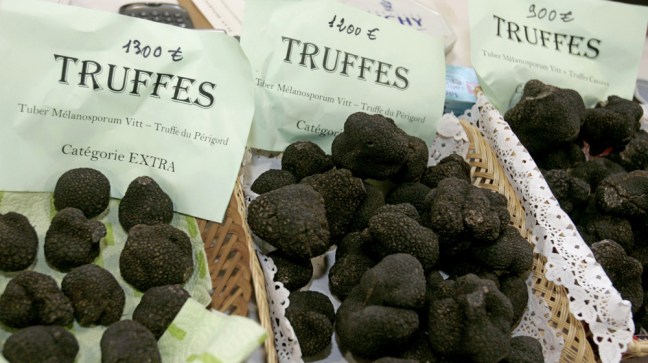
black Périgord truffles © 2012 Reuters
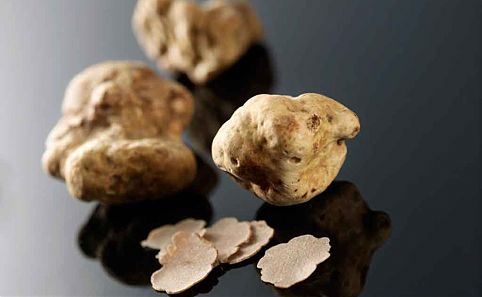
Italian white truffles

When you look at a truffle of the fungal variety, you can certainly see why it takes its name from the Latin word for lump. It’s definitely not a pretty thing, but the taste … well, it’s simply amazing. There is a reason, after all, why the black Périgord sells for as much as $800 a pound and the white variety sells for as much as $2,000 a pound! Continue reading Truffles: mushrooms, chocolate, and … dogs?

It’s bissextile …

Monday afternoon, I realized something fairly mundane but nonetheless rare: it was Leap Year and today was going to be Leap Day. Sitting at my desk, I turned to Michel and I started to tell him that (in French, because we almost always speak in French now), but I stopped short when I couldn’t find the word …

“Hé, Michel. Mercredi, on sera le jour de … euh … c’est le …
tu sais … le 29 février. Comment on dit ça en français?”
“Hey, Michel. Wednesday is the day of … um … it’s the …
you know … the 29th of February. How do you say that in French?”

“Oh, c’est la bissextile.”
“Oh, it’s the bissextile.”

<one raised eyebrow>

“Euh, la quoi?”
“Uh, the what?”

After my brain had a few seconds to parce the word and realize it had nothing to do with what I thought I’d heard, I started to wonder how the French came up with the name. It didn’t seem to have anything at all to do with leaping, or jumping, or hopping …

As usual, I did a little low-level research (meaning lots of Wikipedia articles). Michel was actually using the French adjective describing Leap Year. The adjective bissextile and the far less common noun for Leap Day, bissexte, come from the Latin word for the extra day in a Leap Year : bisextus, which itself is formed from bis (twice, second) plus sextus (the sixth). Okay, but why bisextus … why “the second sixth”?

Continue reading It’s bissextile …

The Hedgehog

Sometimes, I run out of witty observations about life in France and I get the feeling that it might be too soon for yet another “interesting” etymological history. Today is one of those days, so I asked myself, “Why not give them a recommendation on something French?” Not a bad idea. So here goes …

I strongly encourage you to run to your local movie store, add to your Netflix queue, or somehow stream to your computer :

Le Hérisson
(The Hedgehog)

I first saw Le Hérisson about a year ago, and it ranks as one of my favorite French movies of all time, along with Le fabuleux destin d’Amélie PoulainLe premier jour du reste de ta vieUn long dimanche de fiançailles (even though I still haven’t seen the end), and La Reine Margot (because, yes, I am a history nerd in addition to being a hopeless romantic, and I embrace that).

Le Hérisson is director Mona Achache‘s adaptation of Muriel Barbery‘s novel L’Élégance du hérisson (The Elegance of the Hedgehog). It’s the story of unexpected connections among the most unlikely of friends: Madame Renée Michel, the  grumpy (and frumpy) 54-year-old concierge of an upper-class Paris apartment building; Paloma Josse, an eleven-year-old resident and amateur nihilist philosopher; and Monsieur Kakuro Ozu, the enigmatic new resident of the building.

Continue reading The Hedgehog

Laissez les bons temps rouler!

About a week ago, I stumbled upon Tremé, an HBO series set in New Orleans after Hurricane Katrina. It’s the story of several New Orleanians struggling to rebuild their lives after the catastrophe. On a grander scale, it paints a poignant picture of a unique culture determined to preserve itself against the odds. In a few days’ time, I had already watched the entire first season; I hadn’t felt such an immediate attraction to a television series in a very long time, and I simply couldn’t stop watching it. The music and the scenery brought back memories of my first and only visit to New Orleans a few years after the hurricane, and I decided that I needed to see it again one day and show its magic to Michel.

© Home Box Office, Inc.

And, of course, all this happened in the days leading right up to Mardi Gras.

Mardi Gras, meaning “Fat Tuesday,” is a Christian holiday marking the end of the season of Epiphany and the beginning of the season of self-sacrifice called Lent (or Carême, in French). It’s the culmination of Carnival season, when you’re expected to indulge (notably in fatty foods—hence the name) in advance of the solemn season that follows. If you’ve ever been to New Orleans—whether at Carnival season or even in November—you know that no one does decadence quite like the Crescent City : think shrimp po’ boys and spicy gumbo, warm beignets dusted with powdered sugar at Café du Monde, and Hurricanes in go-cups.

But why does New Orleans indulge so well? Perhaps it’s because the city can trace its very origins—however tenuously—back to Mardi Gras :

Continue reading Laissez les bons temps rouler!

Suspense. It’s French … sort of.

SUSPENSE

a : mental uncertainty : anxiety
   b : pleasant excitement as to a decision or outcome <a novel of suspense>

— from the Merriam-Webster Dictionary

Suspense is a “French English” word that has a few meanings in our language but is used most often to describe a sense of nervous anticipation, whether the circumstances involve dread or eagerness. For instance, we feel suspense when we’re waiting for someone to make a decision that’s out of our hands :

“Oh, please, please! Let them make a decent offer on my apartment so I can finally sell it!”

“When am I going to hear back from the prefecture? And what am I going to do if they end up refusing to renew my visa?”  

But we can also feel it when we’re watching a television show and the episode ends with a dramatic event, while leaving the story unresolved :

“What in the world are they going to do now? Is he alive or dead? And what am I supposed to do with myself until next week?!”

                                                              … or when we’re reading a book, the chapter ends with a cliffhanger, and despite the fact that we have to get up early the next morning, we just have to start the next one. 

“Suspense” came into Middle English from Anglo-French, one of those lexical imports during the first few centuries after the Norman Conquest. Its first recorded English use was in 1306 in the legal term “en suspens” meaning “not executed, unfulfilled.” By 1440, the word had also developed the sense of a “state of mental uncertainty” … because, I guess, whatever legal judgment that was “en suspens” had not yet been carried out and the future was stressfully unclear. The Anglo-French “suspens” itself derives from the Old French “suspens,” from the Latin  “suspensus” (the past participle of the verb “suspendere“) meaning “delayed.” Continue reading Suspense. It’s French … sort of.

Got a chimney? It’s French.

A while back, I posted about how much of the English language comes from French. Perhaps surprisingly, more English vocabulary comes from French than from any other language source, even Anglo-Saxon—some 30% in fact. Speaking English words of French origin doesn’t make us French speakers, of course, but stumbling across these cognates can be pretty useful if you’re in a French class … or even trying to decipher a French menu. Being an etymology nerd myself (and inspired by my blogger friend over at Le mot du (bon)jour), I decided to create a new “column” on je parle américain: the French English Word of the Week. Every week or so, I’ll write a short post about an ordinary English word that we inherited from French. Sometimes, the French and English words will have exactly the same meanings. Sometimes, though, they’ll be faux amis (“false friends”), because the words have evolved differently over time. Those can be the most interesting!

So, this week’s French English word? Given the record-breaking cold temps affecting many of my readers, I’ve decided to kick things off with:

chimney

Everybody knows what a chimney is, of course. In its primary sense, chimney means “a vertical structure incorporated into a building and enclosing a flue or flues that carry off smoke; especially : the part of such a structure extending above a roof.” (Merriam-Webster Dictionary)

“Chimney” comes to us from the Anglo-Norman chiminee from the Old French cheminée from Late Latin caminata from Latin caminus from Greek kaminos, meaning “furnace.”

In American English, we use the word almost exclusively for the structures that carry off smoke from our homes. We generally call the industrial versions or the versions on steam locomotives and steamships “smokestacks.” In England, by contrast, such smokestacks are often called chimneys and, in some English dialects, chimney can also mean a “fireplace or hearth,” especially a large one, like those found in old castles.

Continue reading Got a chimney? It’s French.

A Love Lock?

As a hopeless romantic, I just love anniversaries, and Michel and I celebrate a lot of them: the day we met … our first real date … our engagement … our marriage … the first time we ate ice cream together (okay, maybe that one is an exaggeration—but just barely). We don’t stop with anniversaries, though; we even celebrate the “monthaversaries,” as in “Today is 17 months since … blah, blah, blah.” Some of my friends used to joke about my monthly spate of Facebook dedications, but they’ve grown awfully quiet these days. They must have all just suppressed me from their newsfeed. After almost three years together, I guess marking monthaversies had become old-hat.  So, a few weeks ago, I asked myself: “Why not celebrate a different date—some unusual milestone?” Well, geeky hopeless romantic that I am, I did the math and determined that today—February 12—marks one thousand days since we said those magic words to each other for the very first time:

I love you.

Je t’aime, aussi.

Pretty good idea, huh? But how to celebrate? Well, living in Paris definitely puts the pressure on you to come up with something extraordinary. Paris doesn’t have a monopoly on romance, of course, but there is something magical about this city that can turn the most ordinary of moments into a scene from a sappy romantic comedy:


(Don’t skip the video! It’s really cute.)

So what did I come up with? A crêpe sucrée? A crème brûlée? Beret shopping? Well, no. I didn’t want my little Phineas to miss his cue, so I decided to get a cadenas d’amour

a “love lock.” Continue reading A Love Lock?

Previous Post

To tide you over until the next post from je parle américain, allow me to share this humorous article from my blogger friend over at Le mot du (bon)jour. (To read the whole article, click on the link “Reblogged from Le mot du (bon)jour” above.) I recently wrote about how much French is actually in the English we speak, and her post highlights the confusion that can arise from mixing French and English without considering how a French person will interpret it. Now, as a die-hard Clemson Tiger, I have to take issue with the first sentence of her post because, well, if I were at Williams-Brice, it would be to cheer for the other team! Nevertheless, today’s “mot rigolo” (“funny word”) is guaranteed to make you chuckle!

Enjoy!
And come back Sunday for the next post from je parle américain!

FrenchNad's avatarLe mot du (bon)jour

If you ever go to a USC (that is University of South Carolina) football game, you will find yourself screaming “Go cocks!”… Very strange at first! We brought my French sister and brother-in-law to a game a couple of years ago, and we could not stop laughing because the other side of the stadium was prompted to scream “Game”, and our side had to scream “Cocks”… this lasted a whole game. So we translated with the alternative meaning of cock=rooster (so right, the other meaning…), and in French, that is: “Allez les bites!” (We wanted to text it to the big board but it did not work… I wish! I would have taken a picture!).

View original post 136 more words

Looking for work, or walking off the job?

Strikers at Roissy-Charles-de-Gaulle yesterday. Photo from Reuters

The News

Besides the record-breaking cold temperatures, the big news this week in France is the grève — the strike — at Air France. Essentially a “strike about the right to strike,” it was called by the unions representing Air France’s pilots, cabin crews, and ground crews to protest legislation that would impact their right to walk off the job. Now, you should know up front that workers’ rights are a big deal in France: the 35-hour workweek, generous unemployment benefits, and strong union representation are ingrained in the national consciousness here. As a matter of fact, the right to strike (“le droit de grève“) is actually enshrined in the French Constitution of 1946. Nevertheless, since 2008, railway and bus employees have been subject to a regulation to ensure “the continuity of public service” in ground transportation by requiring 48-hour notice of the intent to strike and the provision of “minimum service” during the strike. Last month, the Assemblée Nationale passed legislation expanding this regulation to include air travel as well, and the Senate is expected to take it up later this month. That, in a nutshell, is why the departures board at Charles-de-Gaulle was lit up in red today. Continue reading Looking for work, or walking off the job?